Showing posts with label 1986. Show all posts

Monday, February 8, 2016

Mario Bros.

Name: Mario Bros.
Year: 1986
Publisher: Nintendo
Developer: Nintendo
Genre: Arcade, Platformer (Single Screen)
Hours Played: Countless
Beaten: N/A
High Score: 77,710
After Donkey Kong (1981) but before Super Mario Bros. (1985) came the arcade game Mario Bros.  Although it was a one-screen platformer, in the vein of it's predecessor, it would introduce many of the elements that would become Mario staples, including sewer pipes, malevolent turtles, momentum when you run, falling from any height, and of course Mario's green-clad brother Luigi.

Every level has the same layout, and features Mario (and in two-player co-op mode, Luigi) running around platforms, attempting to hit enemies from beneath to stun them and then touch them head-on to knock them out of commission.  Like many older arcade games, the challenge comes from keeping track of everything on screen at once; stunned enemies get up and move faster if ignored for too long, fireballs appear unexpectedly at the edge of the screen, and sentient icicles can freeze platform sections.  For true chaos, add in a second player; bumping into them can send both of you ricocheting into enemies (a mechanic later revisited in the New Super Mario Bros. games).

Unlike so many of the games in it's vault, Nintendo has figured out exactly where this game belongs: as a free mini-game. You can play a slightly updated version as a battle game in Super Mario Bros. 3, play it in full from the SMB3 title screen in Super Mario Bros. All-Stars, and it's included in numerous Game Boy Advance Titles (Super Mario Advance 1-4, Mario & Luigi).  Interestingly, all of these use the NES version of the game, as opposed to the technically superior arcade version, suggesting that Nintendo considers this the "real" version of the game (or at least the easiest to port).

Mario Bros., along with Balloon Fight, was one of the first competitive co-op games, and still holds up when played with two players.  That being said, it's short length made it difficult to justify a $50 price tag even back in 1986, and with the release of Super Mario Bros. 3 in 1990, this cartridge became all but obsolete.

Graphics & Animation: 3 (Average)
The graphics here are pretty good;  Mario, the green sewer pipes, and the Koopas (known back then as "Shellcreepers") are instantly recognizable.  For such  a short game, though, I wish they could have included the extra animations from the arcade game (Mario burning when he touches a fireball, turles stepping outside their shells and flipping them over, etc).

Music & Sounds: 1 (Bad)
No in-game music (except little ditties when the game starts), and the sound effects, while effective, are sparse.  Not much to say because there's not much here.

Controls & Level Design: 4 (Good)
The controls in Super Mario Bros. are top-notch, and it's easy to see why: Nintendo was perfecting them all the way back with this game.  Although there's no "run" button, momentum (jumping higher when running, sliding when you turn quickly) still plays a huge part in this game, forcing you to be aware of enemies' positions at all times lest you leap headfirst into one...

Story & Presentation: 1 (Bad)
Not much to say here.  The title screen looks pretty good (better then most of the black box arcade games, actually), and there's a nice little melting effect when the icicles freeze the platforms... and that's about it.

Length & Replayabilitiy: 1 (Bad)
Multiplayer is the only reason to keep coming back to this game, but even then, you're going to get tired of Mario Bros. pretty quickly.

Total: 9 (Average)

Friday, December 4, 2015

The Legend of Zelda

Name: The Legend of Zelda
Year: 1986
Publisher: Nintendo
Developer: Nintendo
Genre: Action Adventure
Hours Played: Countless
Beaten: Yes, countless times
Nowadays, the story behind Miyamoto's inspiration for The Legend of Zelda is well known - he wanted to recreate the feelings of exploration and discovery he had when exploring mountainsides and caves near his home as a boy - but when I first read this in the early 2000s, it made complete sense to me.  Gamers today complain about the game's cryptic nature (made seemingly more antiquated by the tutorials and hand-holding nature of so many modern games), but The Legend of Zelda was designed as a mystery for players to slowly unravel.  To this day, it's the only game series I know that marks the occasion (with a special sound effect) whenever the player uncovers a secret - not an item or a tool, but an entrance or passageway that was previously hidden.  It creates a sense of exploration that makes you want to keep scouring Hyrule and plump it's hidden depths.

If I had to use one word to describe The Legend of Zelda, it would be "immersive".  To the casual passer-by, the graphics aren't overly impressive - certainly not the game you'd use to show off the prowess of the NES.  But pick up the controller for five minutes, and the game's rich atmosphere sucks you in.  While complaints about the game's cryptically aren't completely invalid (especially in the second quest), if you're attentive you'll notice the subtly placed clues and the paths designed to lead the player in a particular direction.  It's a testament to amazing level design that the game starts you off in the middle of a maze, and yet most players stumble across the entrance to the first dungeon in their first five minutes of playing.

The Zelda franchinse has went in a lot of different directions since it's debute in 1986.  Some games are more puzzle heavy, some more story heavy; few of them retain the emphasis on combat from the early games.  Every gamer has their opinion on what a Zelda game "should" be like.  But if you're willing to put aside your preconceptions and give it a chance, you'll find a game that still holds up after thirty years.

Graphics & Animation: 3 (Good)
The graphics in Legend of Zelda are iconic, and everything is nicely detailed. A lot of creativity went into the game's enemies and bosses - you won't be fighting rats and crows here.

Music & Sounds: 4 (Excellent)
Zelda games still use the overworld theme from this game today, thirty years later - that's how memorable and iconic it is.  The hits and deflection sound effects all sound just right, and the jingles that play when you find an item or uncover a secret are just as memorable as the theme song.

Controls & Level Design: 4 (Excellent)
People who cut their teeth on Link To The Past tend not to think too much of the original Zelda's controls, but I disagree.  Link (and most enemies) move only in the four cardinal directions, no diagonals, and the game's combat is built around this; for instance, standing around a corner waiting for the enemy to waltz past.  It always gives me the impression of grid-style combat with tabletop miniatures, only in real time.

Story & Presentation: 3 (Good)
When the game first loads up, there's a text-only cut scene (including a cool day-to-night transition on the title screen) which brings you up to speed on the story, and a list of all the items you'll find on your adventure.  At the end of the game, there's the awesome (albeit brief) Ganon death sequence and a cut scene epilogue.  It's all great; but unfortunately that's all the story you'll get.  Zelda II found a way to give you bits of backstory through townspeople dialog and location names (such as the destroyed and relocated town of Kasuto), but there's not much of that here.

Length & Replayabilitiy: 4 (Excellent)
So much to do in this game! Legend of Zelda is already one of the longer games on the NES, with all the secrets to uncover and dungeons to explore, and then once you've completed the game, there's a second quest with remixed dungeons and rearranged overworld locations.  All in all, this game will keep you coming back for a long time.

Total: 18 (Excellent)

Friday, November 13, 2015

Donkey Kong 3

Name: Donkey Kong 3
Year: 1986
Publisher: Nintendo
Developer: Nintendo
Genre: Arcade
Hours Played: Countless
Beaten: N/A
"This game's a lot easier with a turbo controller" - that sentence right there should tell you that Donkey Kong 3 is pretty different from it's predecessors.  The first thing you'll notice is you don't play as Mario in this game - instead you take the role of Stanley the Bugman, a non-mustachioed, non-overalls-wearing exterminator.  With the help of his trusty Flit gun, Stanley protects his greenhouse and his crops from Donkey Kong and his horde of thieving insects.

So yeah, you've probably already gathered that the game doesn't have a lot to do with the titular ape.  It's basically a one screen shooter - Stanley can move left and right, and jump up and down three levels of bleachers (?) to get a clear shot at his attackers.  Buzzbees will steal your crops (lose all five and lose a life), Queen Bees exploed when shot, and snakes will craw in your way and block your shot.  Donkey Kong himself hangs in the center of the greenhouse.  Shoot bugspray up his butt and he climbs upwards; ignore him and he'll slowly shimmy downwards, until he lands on the bleachers and you lose a life.  Force him to the top of the screen and you proceed to the next level.

The challenge in this game comes from keeping track of everything at once.  Focusing on shooting Kong is the fastest way to end the level, but that leaves the insects free to attack you or steal your vegetables.  Focus too much on the insects, and Kong will drop down and end the game.  It makes the game frantic and really keeps you on your toes; unlike most older arcade games, it's hard to get into a rhythm, because the focus of your attention keeps changing.

Of all the Donkey Kong games, this one is clearly the black sheep of the family.  Oddly enough, it also appears to be the one Nintendo put the most effort into porting from the arcade.  For instance, it's the only one to keep the level progression style of the arcade games: First you play screens 1 and 4, then 1, 2, and 4, then 1, 2, 3, and 4.  This game also boasts the most frames of animation for Donkey Kong; it's just too bad they also gave him a redesign.  All in all, I wouldn't call it a terrible arcade game; it's just not fun or interesting enough to warrant a revamp of the series.

Graphics & Animation: 1 (Bad)
How sad is it that DK looks better in Donkey Kong Jr Math then he does in this game?

Music & Sound: 1 (Bad)
The music here lacks the iconicness of Donkey Kong and Donkey Kong Jr, and it's repetitive, but at least it changes when you grab a power-up.n

Controls & Level Design: 2 (Average)
The controls in this game, in true Nintendo fashion, handle pretty well.  Pressing up causes Stanley to jump, and down drops him through the floor.  It may sound strange, but it feels very natural.

Story & Presentation: 2 (Average)
Another nice touch that survived the transition to console is the cut scenes before and after each level.  At the beginning of a stage, DK knocks on the hornets nests and stirs them up; he winces when you spray him, and at the end of the last screen a beehive gets stuck on his head.  It all helps you know exactly what's going on.

Length & Replayability: 0 (Awful)
Donkey Kong 3 might be able to keep you coming back in the arcades, but it's hard to picture someone spending much time with it on the NES.

Total: 6 (Bad)

Thursday, November 12, 2015

Donkey Kong Jr. Math

Name: Donkey Kong Jr. Math
Year: 1986
Publisher: Nintendo
Developer: Nintendo
Genre: Educational
Hours Played: Half an hour
Beaten: N/A
One of my rules in reviewing games is to make sure I've played each game for a minimum of half an hour.  Since I have to beat each game, it's rarely an issue; there's only two games (so far) that have hurt to play that long.  The first one was Color a Dinosaur; the second is Donkey Kong Jr. Math.

Now, I'm not the kind to hate on a game just for trying to teach kids something - as a former aspiring educational game designer, I loath how "edutainment" has become a dirty word. But this game is painful.  There's three modes: "Calculate A", "Calculate B", and "Exercise".  "Excerise" is graphically based off the fourth screen on Donkey Kong Jr, and feels the most like a math game; the game gives you an equation and you have to solve it.  The weird thing is how you solve it; you climb up chains in increments.  Yeah, that's just as weird as it sounds.

"Calculate A" is the mode you always see in screen shots - it looks like the first screen in Donkey Kong Jr, but full of numbers.  Did you know that Donkey Kong Jr. Math is by default a two-player game?  I sure didn't! And by "default" I mean there isn't a one-player option! (Except for "Excerise" mode) DK JR is on the left side of the screen while a second, pinker DR JR sits on the right side.  Donkey Kong (Sr) holds up a sign with a two or three digit number, and then the two babies race to create the number by collecting combinations of single digit numbers and operators (plus, minus, multiply and divide).  So for example, if he holds up 400, you could multiply 9 by 5 to get 45, then multiply by 9 to get 405, then subtract 5 to get 400!  Fun, right?

The basic problem with this game - besides the awful controls, and the fact that it isn't any fun - is that it's a math game that doesn't teach math.  At least "Exercise" mode lets you practice math exercises.  The "Calculate" modes ("Calculate B" is the same thing, only you have to create negative numbers!) is complicated and unintuitive - even if they had a 10 you could multiply by, it might be playable.  Oh, and the numbers you pick from are random, so there's no guarantee they'll have the one you need!  Learning games tend to be skewed towards younger players, but I'm having trouble picturing the kid who could work all that out with negative numbers and also be willing to play this game.  Bottom line: I'll take Math Blaster any day of the week.

Graphics & Animation: 1 (Bad)
The only redeeming thing about this game is the graphics - it looks just like Donkey Kong Jr! On the other hand, that might be a bad thing - like the game is taunting you that you could be playing a real game.

Music & Sound: 0 (Awful)
The music sounds like you're playing a Donkey Kong Jr. rip-off where they changed just enough notes to not get sued.  Also, you get to listen to a four-second loop while doing math!

Controls & Level Design: 0 (Awful)
How can you break Donkey Kong Jr?? They could have just made a calculator interface and it would have been much easier to play.

Story & Presentation: 0 (Awful)
Maybe the manual has some sort of backstory where Donkey Kong is trying to teach his son math? Could be, but I doubt it could explain DK JR's pink clone.

Length & Replayability: 0 (Awful)
Just be grateful it's so short!

Total: 1 (Awful)


Popeye

Name: Popeye
Year: 1986
Publisher: Nintendo
Developer: Nintendo
Genre: Arcade
Hours Played: Half an hour
Beaten: N/A
Although the Nintendo Entertainment System released in America in October 1985, the first wave of licensed games (i.e. games made by companies other then Nintendo) didn't release until a year later, in October 1986.  That means that for one whole year, the only games available for the system are what's now known as the Black Box Series, became they came in black boxes, and each was labeled as being part of a different series (action series, sports series, etc).  The second of the three waves, released in June 1986, was labeled the Arcade series, and consisted of six games: four Donkey Kong games (including Donkey Kong Jr. Math), Mario Bros. (the one screen arcade game), and Popeye.

It's become part of gaming lore that Donkey Kong, the arcade game that put Nintendo on the map, was originally intended to be a Popeye game, before the licencing deal fell through. A year later, Donkey Kong was one of the most popular video games of all time, and Nintendo was able to secure a deal and release Popeye.  Besides being an early NES release in America, it was actually one of the first three games (alongside Donkey Kong and Donkey Kong Jr) to be released for the Famicom in Japan.

With all that backstory, I was very interested to see if this game holds up to Donkey Kong.  And... it doesn't.  Olive Oil (Popeye's girlfriend) stands at the top of the screen and throws items.  As Popeye, you have to run around and collect them while avoiding Bruto, who strolls around the screen and attacks you in various ways.  The first thing you'll notice is the lack of a jump button - you can move, climb ladders and stairs, and punch.  Your punch bizarrely doesn't work on enemies, but allows you to activate certain items and block certain projectiles.  The main challenge in the game comes from Bluto.  He casually wanders the levels, but has a large range of attacks, from throwing projectiles, to attacking the platform above or below, and his attacks are pretty random, making him a threat no matter where in the level you're at.

Popeye isn't a bad game by any means; it just feels like Nintendo's attempt to redo Donkey Kong without redoing Donkey Kong.

Graphics & Animation: 2 (Average)
The graphics here are pretty good!  All the Popeye characters are easily identifiable, and the item you're collecting changes each level.  The hearts that fall from the top are nicely animated, too.  The backgrounds aren't quite as impressive, though... the third level ship in particular looks a little Atari-tastic.

Music & Sound: 3 (Good)
The music and sound effects are the real star here.  The music is constantly changing according to what's going.  There's the regular level music, the Bruto attacking music, the hurry-up music that plays if you let a heart (or note or letter) fall in the water, and of course a great Nintendo rendition of the Popeye theme.

Controls & Level Design: 2 (Average)
A large part of the game is running up and down staircases to avoid Bluto, and the control is silky smooth - why can't Simon Belmont climb steps like this?  Popeye's punch hangs in the air for a second, and would feel super satisfying, if they let you use it to punch enemies...

Story & Presentation: 2 (Average)
The cameos from the various Popeye universe help give the game personality, and a little cutscene on the third screen helps explain what's going on (on the first two levels, you're romancing Olive Oil; it's only on the third level that you're rescuing her).

Length & Replayability: 0 (Bad)
Like NES Donkey Kong, it's just three levels, over and over and over....

Total: 9 (Average)

Wednesday, November 11, 2015

Othello

Name: Othello
Year: 1986
Publisher: Acclaim
Developer: HAL Laboratory, Inc.
Genre: Board Game
Hours Played: 2
Beaten: Yes, using saves states
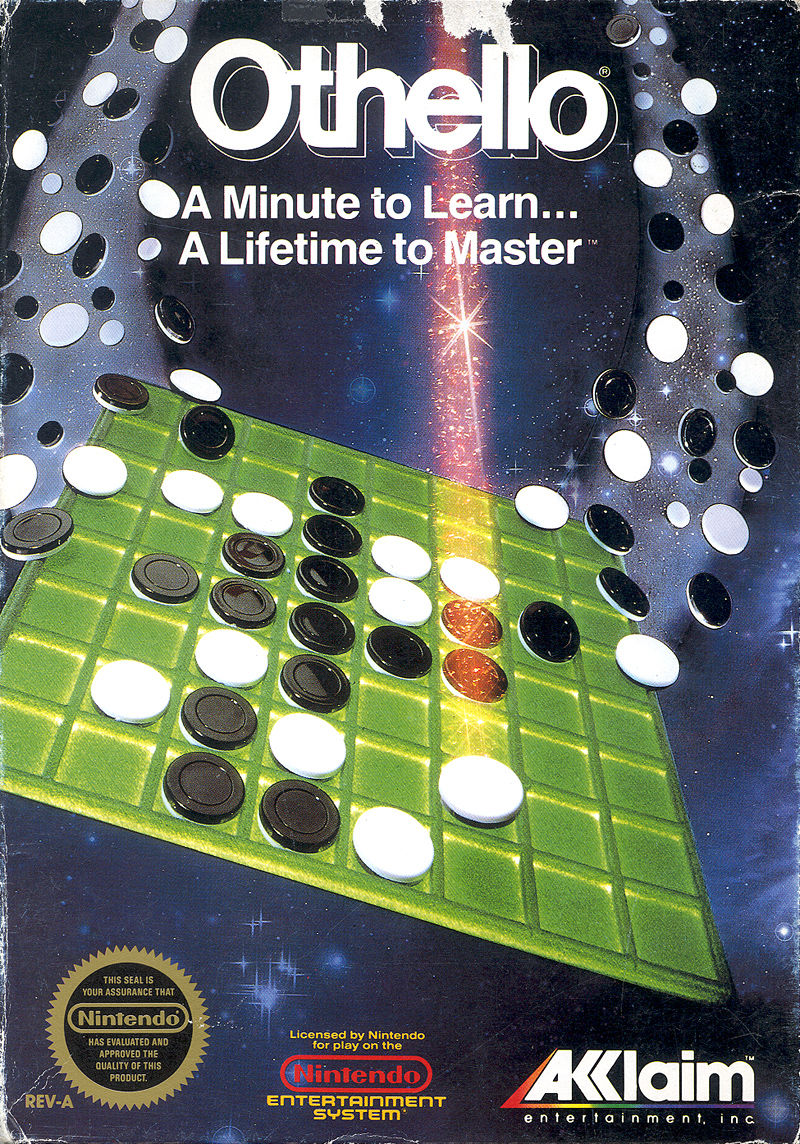
Othello (trademarked by Mattel; also known as Reversi) is an abstract board game, sort of a simplified Go, in which players take turn flipping pieces to their color.  The game ends when the board is full, and whoever have the most pieces in their color wins.  As the trademarked slogan suggests, the board game has maintained popularity due to being easy enough for little kids to fully understand but enough strategy for adult to keep coming back.

This is a pretty no-frills interpretation of Othello.  Don't expect Spot: The Video Game, where pieces get up and walk around where you move them - this is literally a board game on your NES, no more, no less.  I do have to admit the menu system is pretty nice - you can chose amount of players, difficulty, who starts first, and time limit, and when a match is over you can choose to play again using the same options or to set up new rules.

I get the impression that Acclaim was aiming this game at the serious Othello enthusiast, as opposed to kids who like board games.  I dunno, do people play Othello using chess timers? Or did they in the eighties?  Because this game includes the option.  Either way, I wouldn't say the game lacks personality - it just takes itself very, very seriously.

Graphics & Animation: 1 (Bad)
The graphics get the job done, and that's really all I can say about them.  I hate to sound picky, but if literally the only thing you're required to draw for your Nintendo game is black and white Othello pieces, they'd better be the prettiest darn Othello pieces you've ever seen.  These are circles.

Music & Sound: 1 (Bad)
Music on the title page, music on the menu page, and the sound effect get the job done.  I was literally playing the game five minutes before writing this paragraph and I couldn't tell you what the music sounded like.

Controls & Level Design: 2 (Average)
The controls works exactly like you'd expect them to.  I was never confused or unable to play, and I never made the wrong move by mistake.

Story & Presentation: 1 (Bad)
The presentation on this game is pretty no-frills.  There's vines on the title screen and a coat of arms on the game screen, and that's about it.  Not even a cutscene if you (finally) beat the computer, but it does count out the pieces for each player at the end of a game.

Length & Replayability: 1 (Bad)
There's a two player option and difficulty options, but unless you're a true Othello enthusiast, you're gonna get bored pretty fast.

Total: 6 (Bad)

Donkey Kong Jr.

Name: Donkey Kong Jr.
Year: 1995
Publisher: Nintendo
Developer: Nintendo
Genre: Arcade
Hours Played: Countless
Beaten: N/A
Donkey Kong Jr. (spelled different from "Donkey Kong Junior" in the arcades) was the sequel to the original Donkey Kong (so much that they called the third game "Donkey Kong 3").  It's similar to it's predecessor - beat four one-screen levels, rinse and repeat, but while the first game focused on jumping, this game adds a climbing element that becomes the focus of most levels.

The first two screens of Donkey Kong Jr. are great - like the original, there's multiple paths to take thru the level.  The third screen is a disappointment, as it focuses on jumping over climbing, making it feel more like the original game, but it's very linear, with only one path through the level.  The fourth level is nice, as it's reminiscent of the last Donkey Kong level, except (once again) with a heavy climbing element.

While Donkey Kong Jr fairs better then it's predecessor in terms of length (all four levels made the transition this time), it takes a much bigger hit in the graphics department.  Gone are all of Papa DK's animations - now he's just a static monkey in a cage.  The cut scenes once again took a big hit, with only the fourth level "ending" remaining.

Graphics & Animation: 2 (Average)
The graphics are a little more colorful in this game then the original, but the lack of animation on Donkey Kong Sr. hurt it.

Music & Sounds: 2 (Bad)
Only one level has music, and it lacks the memorability of the iconic Donkey Kong theme.

Controls & Level Design: 3 (Good)
Unlike graphics or gameplay, good controls don't age.  You may die from a cheap shot, but you'll never die because Kong didn't go where you told him to.

Story & Presentation: 0 (Awful)
The cut scenes are gone from this game, and I miss them more then I did in Donkey Kong.  In that game, it was instantly obvious you were trying to rescue the girl from the monkey throwing barrels, even if you weren't given any explanation.  In this game, without any context, I feel like the story and the goal are a little more confusing - especially nowadays, when the idea of Mario being a bad guy is pretty shocking.

Length & Replayability: 1 (Bad)
The length of this game fairs a little better then the first - there's four levels instead of three, and I feel like the levels (at least the first two) offer a little more variety.  It still gets old pretty fast, though.

Total: 8 (Average)