Showing posts with label Nintendo. Show all posts

Monday, February 8, 2016

Mario Bros.

Name: Mario Bros.
Year: 1986
Publisher: Nintendo
Developer: Nintendo
Genre: Arcade, Platformer (Single Screen)
Hours Played: Countless
Beaten: N/A
High Score: 77,710
After Donkey Kong (1981) but before Super Mario Bros. (1985) came the arcade game Mario Bros.  Although it was a one-screen platformer, in the vein of it's predecessor, it would introduce many of the elements that would become Mario staples, including sewer pipes, malevolent turtles, momentum when you run, falling from any height, and of course Mario's green-clad brother Luigi.

Every level has the same layout, and features Mario (and in two-player co-op mode, Luigi) running around platforms, attempting to hit enemies from beneath to stun them and then touch them head-on to knock them out of commission.  Like many older arcade games, the challenge comes from keeping track of everything on screen at once; stunned enemies get up and move faster if ignored for too long, fireballs appear unexpectedly at the edge of the screen, and sentient icicles can freeze platform sections.  For true chaos, add in a second player; bumping into them can send both of you ricocheting into enemies (a mechanic later revisited in the New Super Mario Bros. games).

Unlike so many of the games in it's vault, Nintendo has figured out exactly where this game belongs: as a free mini-game. You can play a slightly updated version as a battle game in Super Mario Bros. 3, play it in full from the SMB3 title screen in Super Mario Bros. All-Stars, and it's included in numerous Game Boy Advance Titles (Super Mario Advance 1-4, Mario & Luigi).  Interestingly, all of these use the NES version of the game, as opposed to the technically superior arcade version, suggesting that Nintendo considers this the "real" version of the game (or at least the easiest to port).

Mario Bros., along with Balloon Fight, was one of the first competitive co-op games, and still holds up when played with two players.  That being said, it's short length made it difficult to justify a $50 price tag even back in 1986, and with the release of Super Mario Bros. 3 in 1990, this cartridge became all but obsolete.

Graphics & Animation: 3 (Average)
The graphics here are pretty good;  Mario, the green sewer pipes, and the Koopas (known back then as "Shellcreepers") are instantly recognizable.  For such  a short game, though, I wish they could have included the extra animations from the arcade game (Mario burning when he touches a fireball, turles stepping outside their shells and flipping them over, etc).

Music & Sounds: 1 (Bad)
No in-game music (except little ditties when the game starts), and the sound effects, while effective, are sparse.  Not much to say because there's not much here.

Controls & Level Design: 4 (Good)
The controls in Super Mario Bros. are top-notch, and it's easy to see why: Nintendo was perfecting them all the way back with this game.  Although there's no "run" button, momentum (jumping higher when running, sliding when you turn quickly) still plays a huge part in this game, forcing you to be aware of enemies' positions at all times lest you leap headfirst into one...

Story & Presentation: 1 (Bad)
Not much to say here.  The title screen looks pretty good (better then most of the black box arcade games, actually), and there's a nice little melting effect when the icicles freeze the platforms... and that's about it.

Length & Replayabilitiy: 1 (Bad)
Multiplayer is the only reason to keep coming back to this game, but even then, you're going to get tired of Mario Bros. pretty quickly.

Total: 9 (Average)

Monday, January 25, 2016

Yoshi's Cookie

Name: Yoshi's Cookie
Year: 1993
Publisher: Nintendo
Developer: Bullet-Proof Software
Genre: Abstract Puzzler
Hours Played: 2
Beaten: No
When Tetris first came to the States from Russia in 1984, there were a lot of legal battles over who owned the rights (in Russia, according to laws at the time, the game was owned by the government and not the creator).  After many lawsuits, Nintendo ended up with the rights to the game, but only for a limited period of time.  They used those rights to push the Nintendo and especially the Game Boy to success (as Tetris co-creator Henk Rogers stated, "Tetris made Game Boy and Game Boy made Tetris").  The downside of all this was that Nintendo knew they couldn't keep the rights forever, and so the search was on to come up with a replacement.  Hence, during the NES's lifespan, Nintendo came out with a number of abstract puzzlers, including Yoshi, Dr. Mario, and Wario's Woods.  The game we'll be looking at today is Yoshi's Cookie.

Yoshi's Cookie is neither the best nor the worst of these games released by Nintendo; what it is is the most reflex based and least contemplative of the series.  At first glance, it looks like a predecessor to Candy Crush - everything from the arranging pieces game play to the confectionery theme feels immediately familiar.  But spend a couple of rounds with the game, and the huge differences quickly become clear. The relaxed gameplay in games like Bejeweled and Candy Crush is nowhere to be found; the emphasis in Yoshi's Cookie is strictly on making matches as quickly as possible before you get overwhelmed and the screen fills up, Tetris style.

The gameplay is simple: you have cookies in a rectangle-shaped grid, and more cookies fly in from the top and the right.  Arrange a row or column so that all the cookies match, and it clears that line.  Clear all the cookies, and you progress to the next stage.  The basic problem here is that the extra cookies come flying in pretty quickly, so it's near impossible to formulate any kind of long-term strategy; your only bet is to clear the screen as quickly as possible.  From what I've been able to determine (from my own gameplay and making family and friends try it), if you can't clear a screen in less then 30 seconds from when you start, the statistical chances of you making a comeback and beating it are very low.  It stops you from ever getting into the classic puzzle-game "trance"; you're too busy staying constantly on your toes.

As an experiment, I had my wife, who's obsessed with beating Candy Crush without purchases, try the game.  To my surprise, I (who hates Candy Crush) was much better at is then her; her abstract puzzle-solving strategies weren't nearly as useful as my gamer reflexes.  The end result is that the game doesn't satisfy either audience; she'd rather be playing a game at a casual, relaxed pace, and I'd rather be shooting bugs and stomping mushrooms.

Graphics & Animation: 2 (Average)
The graphics here aren't anything to write home about, but they are a lot of fun.  Everything here is easily identifiable, especially the cookies, and Yoshi looks pretty good rendered on an 8-bit system.

Music & Sounds: 1 (Bad)
The music here is pretty forgettable.  Not to compare games, but the Super Nintendo version has an opening theme that manages to sound like a Mario game without copying music from other games; why couldn't the NES version have anything that memorable?

Controls & Level Design: 1 (Bad)
The controls in this game are frustrating.  Unlike some puzzle games which purposely limit how you can move pieces (Yoshi, Tetris Attack/Puzzle League), in Yoshi's Cookie you're free to move any piece to any spot you like; so why make the controls so awkward?  Instead of simply picking and moving a piece, you grip a piece and then use the D-pad to slide that row or column around, sort of like a 15 puzzle game.  The titular Yoshi's Cookie (a cookie shaped like Yoshi's Head) is suppose to serve as a wild card, but it's extremely difficult to get it where you want it without accidentally making a match on the way.

Story & Presentation: 4 (Excellent)
The game is called "Yoshi's Cookie", and they drive that theme home wherever they can.  Mario wears a chef's outfit to oversee the playing field, and little Pac-Man-esc cutscenes play out every ten levels where Mario opens boxes of cookies and tries to hide them from Yoshi.  It's silly, but they still went the extra mile to include it,

Length & Replayability: 1 (Bad)
Kudos to the game for having a two-player mode, but also including a puzzle mode where you clear pre-designed boards (like the Super Nintendo version of Yoshi's Cookie) would have went a long way towards giving this game more replayability.

Total: 9 (Average)

Monday, January 18, 2016

Super Mario Bros. 3

Name: Super Mario Bros. 3
Year: 1990
Publisher: Nintendo
Developer: Nintendo
Genre: Platformer
Hours Played: Countless
Beaten: Yes, countless times
In a lot of ways, Super Mario Bros. 3 was Nintendo's swan song for the Nintendo Entertainment System.  It wasn't the last game they produced for the NES, not by a long shot, but after five years (longer in Japan) of producing games for the eight-bit system, this would be their last concentrated effort before focusing their best and brightest on the NES's successor (the Super Nintendo, released one year later).

Looking back now, it's hard to imagine the hype for this game (everything from commercials to feature-length films), but people were excited, and the game did not disappoint.  Even today, it's generally considered to be the all-time best Mario game, and sometimes even the best game ever made.  Although that last one may be going a little far, there's no doubt that it's an enduring classic that's aged well even today.  But sinse we here at All Game Revue frown at taking a game's legacy in account, let's take a look at the game itself and see if it holds up well against it's NES brethren.

The original Super Mario Bros. was an exceptional platformer that set the standard for what people expected on the NES.  The second game took the series in a different directions and left a lot of fans scratching their heads.  Super Mario Bros. 3 returned to the formula of the original game and expanded upon it in every way possible.  There were more power-ups.  You could now play levels in different orders.  You could even collect power-ups and save them for later use.  Every single enemy from the original game not only returned, but received either upgrades or new variants, and their were a host of new and memorable enemies as well.

The only downside?  I wouldn't call the game "rushed", considering how many levels it has (around ninety!), but there's definetly concepts that don't feel fully utilized.  Fan-favorite items like the Tanooki Suit, Hammer Bros. Suit, and Goomba's Shoe appear in only one or two places in the game; I've often wished they'd placed the suit-wearing gimmick at the forefront of the game (like Capcom's Little Nemo: Dream Master), as it's such an interesting and fun idea.  Still, even this has become one of the game's charms; while most NES games were conservative with their limited resources and wouldn't introduce a power or enemy unless they could use (and reuse) it to it's fullest, Mario 3 wasn't afraid to throw tons of things against the wall to see what sticks.  That's what made it an enduring classic, then and now: you never know what to expect next.  I've been playing this game for over 25 years, and it can still surprise me; that's pretty darn cool.

Graphics & Animation: 4 (Excellent)
The graphics here are terrific!  Nintendo took the already-iconic character designs of the first game and gave them bold black outlines to really make them pop from their surroundings.  The enemies have tons of personality, and the transformations of the kings still makes me smile today.  Nintendo re-released this game with a graphical update (both in Super Mario All-Stars and Super Mario Advanced 4), and a lot of people (including myself) still prefer the original.

Music & Sounds: 4 (Excellent)
Nintendo actually included a special sound chip in the cartridge to create all the drum effects in the game.  The result is music that doesn't sound like anything else on the NES, and really showcases what the machine is capable of.

Controls & Level Design: 4 (Excellent)
The controls here are spot-on.  The level design is excellent, knowing when to show off new features (like flying with the raccoon power-up) and when to give you a straight-forward challenge.  The game is constantly throwing something new at you, meaning you never get bored, and you're always waiting to see what's coming next...

Story & Presentation: 3 (Good)
The presentation here is very creative, with the game being presented as a stage show (complete with curtains and props you can walk behind).  The story is a little lackluster; although it progresses through static cutscenes (letters from the Princess between worlds), it doesn't really go anywhere until (SPOILERS! I guess?) she's kidnapped at the begging of World 8, begging the question of what exactly your quest was before.  Also, the bosses are pretty underwhelming; compared to the giant enemies of the Mega Man series, the bosses here aren't even as intimidating at the normal enemies in World 4.  Still, the gimmick of the kings being turned into animals is pretty entertaining, and it keeps you playing the game to see what animal will be sitting on the throne next.

Length & Replayabilitiy: 4 (Excellent)
This is (in my opinion) the game's greatest strength; Super Mario Bros. 3 is easily one of the most replayable games on the NES.  The full game is massive, but the warp flutes allow you to explore at your leisure; you can skip straight to the end, jump around to your favorite worlds, or try to beat the whole game front to back.  To this day, I still haven't beaten level in the game; World 7 in particular continues to frustrate me, and yet that's never deterred me from loving the game or coming back for more!

Total: 19 (Excellent)

Friday, January 15, 2016

Pinball

Name: Pinball
Year: 1985
Publisher: Nintendo
Developer: Nintendo
Genre:Pinball
Hours Played: One
Beaten: N/A
Before the advent of arcade games, pinball machines reigned supreme as the nation's number one non-gambling quarter muncher.  The premise of pinball machines is simple: a steel ball richoettes around a slightly elevated playing field, and you control paddles to catch, aim, and prevent the ball from falling out of bounds.  When video games hit the home market, adapting virtual pinball machines that people could play at home was a natural fit, and thus, one of the initial sixteen games released for the NES was Nintendo's own Pinball.

Of the six pinball games released for the NES, the boringly named Pinball is easily the worst.  The graphics are bland, the music is non-existent, and there's only one table, making this a game you'll grow tired of very quickly.  There's two screens (an upper level and a lower level) you can bounce in-between, and a sparse number of ramps and bumpers.  There's no real theme to the table, either; there's eggs that hatch into chicks, dancing penguins and seals, and playing cards.  It's a shame since theming is such a big part of real-life pinball machines; the real life Mario pinball game is much more interesting than anything shown here.

The only real interesting thing is a mini-game you access by hitting one of the bonus spots; it takes you to a Breakout-style mini game where Mario bounces the pinball around to rescue Pauline.  It says something about how boring the rest of the game is that the picture on the box is actually from the mini-game.  Unfortunately, the whimsy of the bonus game doesn't seem to jive with the relatively straight-forward presentation of the regular game.

While Pinball is certainly the worst pinball game for the NES, you could argue a lot of the problems (simplistic presentation, only one table) come from being one of the first games released for the system.  What I can't explain, however, is the mishmash of realism (the main tables) and surrealism (Mario-themed Breakout mini game).  There's two camps on how to approach pinball video games: create a realistic simulation (like Pin*Bot), or include video game elements such as enemies and bosses (like Pinball Quest).  Both ways are valid options, and both have their die-hard fans.  The problem comes when you try to have it both ways; you end up pleasing no one.

Graphics & Animation: 1 (Bad)
I wouldn't call the graphics awful; I mean, you can tell what everything is suppose to be.  However, I would call them about as boring and uninspired as humanly possible.

Music & Sounds: 0 (Awful)
If your not going to have any music (besides the generic black box title theme) in your pinball game, that should be because you don't want to distract from your realistic pinball table sounds.  Unfortunately, those aren't so good either.

Controls & Level Design: 1 (Bad)
The controls here are fairly average for a pinball game; with a little luck and a lot of skill, you can get the ball where you want it.  However, I'm docking a point for not having tilt, a feature in pinball video games that mimics the real life technique of shaking the machine a little bit to get the ball over a ledge or slope.

Story & Presentation: 0 (Awful)
As I stated before, every real-life pinball machine has a theme, and every obstacle and bonus mechanism in the game will be centered around that theme.  The game already has Mario in it, so why not feature him, his enemies, and warp pipes on the game's main mode?  Instead, I guess it's a pinball game about... birds and playing cards?

Length & Replayabilitiy: 0 (Awful)
You'll see everything this game has to offer you inside of five minutes.

Total: 2 (Awful)

Wednesday, January 13, 2016

Balloon Fight

Name: Balloon Fight
Year: 1985
Publisher: Nintendo
Developer: Nintendo
Genre: Arcade
Hours Played: Countless
Beaten: N/A
In my review for Excite Bike, I suggest that of the original sixteen games released for the NES (also known as the "black box series"), only Super Mario Bros. and Excite Bike enjoyed popularity in America past their initial run.  You might be wondering, are their any other black box games that still hold up?  The answer is a resounding yes.

Balloon Fight is a game developed by Nintendo and originally released to arcades in 1984.  Conceived as a "clone" (gamer slang for "rip-off") of arcade classic Joust, Balloon Fight expanded upon the formula in enough ways to become a memorable game in it's own right.  In the main game, you play a balloonist who flies around platforms, popping your enemies' balloons while trying to avoid getting your own balloons popped.  When an enemy's balloon is popped, they plummet to the ground, and if they land on a floating platform, you have a few seconds to finish them off before they inflate a new balloon and return as a more powerful opponent (in the tradition of games like Mario Bros. and Bubble Bobble).  Falling into the water underneath the platforms is instant death, and if you hover too near, a hungry fish waits to attack friend and foe alike.  Other obstacles, such as clouds that shoot lighting and the bumpers from Smash Bros, serve to further compound matters.

Balloon Fight improves upon the basic Joust formula in several ways.  First of all, the controls are stronger, and you'll never die from a cheap shot you couldn't react to.  The slippery momentum is gone here, making the controls more about judging how fast you should flap your arms (to gain lift) at any certain time.  There's more level variety here, too; the first three levels serve as a practice, similar to Joust, and then levels four through twelve cycle indefinitely.  Each level has it's own layout and placement of obstacles to keep you on your toes.

The biggest addition here, and something I wish a lot more NES arcade ports had done, is the addition of a second, simple but awesome mini-game called Balloon Trip.  Basically, it's Flappy Bird, almost twenty years before Flappy Bird existed.  You navigate your balloonist through a never-ending randomly generated maze of electric sparks to get the highest score possible.  It's challenging yet oddly relaxing at the same time, and easily qualifies as it's own game, making the fifty dollar price tag a lot easier to swallow.

Balloon Fight is at it's heart a Joust clone, but it expands upon the formula in so many ways, and came out so much earlier then Joust's NES port, that you could be forgiven for assuming Joust ripped off of Balloon Fight.  The greater variety of levels, plus the addition of the excellent Balloon Trip mini-game, makes this "tribute" a clear superior to it's predecessor.

Graphics & Animation: 2 (Average)
The graphics are simple but charming; I especially like the way the enemy bird-men use a bicycle pump to re-inflate their balloons.  Little touches like this, and the animation on the collectible balloons, show how much a little extra attention can elevate a game.

Music & Sounds: 1 (Bad)
The Balloon Fight theme is actually pretty catchy; too bad what you'll mostly hear during gameplay is the annoying bicycle-squeak sound effect of enemy's flapping their wings.  The other sound effects are pretty satisfying, especially popping balloons, and the theme does play on loop during the Balloon Trip game.

Controls & Level Design: 4 (Excellent)
The controls here are great, giving you the perfect blend of challenge and precision.  The level design is a little on the simple side, with little variety, but  it lends itself well to the constant chaos happening on screen at any given time, and the randomly generated nature of Balloon Trip (a rarity on the NES!) means you can play endlessly without getting bored.

Story & Presentation: 2 (Average)
In true arcade fashion, their's basically no story whatsoever (the manual doesn't even give the poor balloonist a name).  The presentation is simple but appealing, with little touches like an animated balloon serving as your menu cursor elevating things a little.  I especially like the fact  that the whole of the game takes place at night, with stars always twinkling in the background; it provides a nice change of pace from the usual "blue skies and clouds" background of so many platforms on the NES.

Length & Replayabilitiy: 3 (Good)
Easily one of the best of the one-screen platform games on the NES.  You can get into that arcade groove, but things are hectic enough that you can never truly relax, and the randomly generated mazes of Balloon Trip ensure you can play forever without getting bored.

Total: 12 (Average)

Tuesday, December 15, 2015

Tetris

Name: Tetris
Year: 1989
Publisher: Nintendo
Developer: Nintendo
Genre: Abstract Puzzler
Hours Played: Countless
Beaten: N/A
Tetris for the Nintendo Entertainment System.  This has been a difficult review to write, because how do you approach it?  Do you approach it from the angle of how this was the definitive version of Tetris for many years and the version still used in professional Tetris competitions to this day?  Or do you approach it from the angle of how it doesn't hold up well compared to modern versions of Tetris, lacking both multiplayer and the ability to "hold" pieces (save them for when you need them)?

Fortunately, the rules of this blog make the answer easy: you ignore the legacy and the versions that came before and after, and focus solely on how it stands up as an NES title.  And the answer is: it holds up very well.  When Tetris was released for the Nintendo, their was nothing else like it, and none of the endless wave of imitators that followed could ever hold a candle to the original.

Moreso then even Super Mario Bros, I have trouble believing their is anyone who would come across this review who's never played a round of Tetris, so I'll keep the synopsis brief: tetrominos fall from the top of the screen, and you arrange them to fill up the well with as few empty spaces as possible.  When a horizontal line is full, it dissapears; if the pieces reach the top, the game ends.  The Nintendo version has two modes: Mode A, which is classic Tetris, and Mode B, in which reaching a certain score ends the game (and plays a little cutscene).

Tetris' biggest selling point is it's accessibility.  It's the one game that attracted sisters and mom who didn't play video games, and is the grandfather of the non-gamer games on mobile devices everywhere today.  It has an important place in gaming history, and the Nintendo version has an important place in Tetris history.

Graphics & Animation: 2 (Average)
The graphics in Tetris do the job, although they aren't anything spectacular.  The palette changes every time you clear a level, which is a nice effect.

Music & Sounds: 1 (Bad)
The Game Boy version of Tetris, released the same year as this one, was the first Tetris to use Korobeiniki, a Russian folk song more famously known in America as "the Tetris theme song".  For the NES version, Nintendo uses as the main theme The Dance of the Sugar-Plumb Fairy, which is a song most Americans associate with Christmastime.  Not only is the lack of the classic iconic Tetris tune dissapointing, but using Christmas music as the theme is... baffling?

Controls & Level Design: 4 (Excellent)
Nintendo is known for games with great control, and they put out (for the time) the definitive version of the game.  Being able to slide over after it's already touched ground has become an integral part of  any serious Tetris player's strategy.

Story & Presentation: 3 (Good)
NES Tetris has a very nice presentation.  The background is made of Tetris pieces, and (as was common in early versions of the game) there is a strong Russian theme present.  Little cutscenes play out when you get to a certain score, which is a nice little extra.

Length & Replayabilitiy: 4 (Excellent)
With so many puzzle and board games on the NES, it's easy to feel ripped off that you're only doing one thing over and over, as opposed to the variety found in games like Super Mario Bros.  And I've certainly complained about high score-centric games on a system that can't save your high score.  But something about the addictive nature of Tetris keeps people coming back and back again, and the NES version has just the right slow steady pace of speeding up to always make you feel like you could have done just a little bit better...

Total: 14 (Good)

Super Mario Bros.

Name: Super Mario Bros.
Year: 1985
Publisher: Nintendo
Developer: Nintendo
Genre: Platformer
Hours Played: Countless
Beaten: Yes, countless times
In the early eighties, most video games were about one thing.  Space Invaders was about shooting aliens, Pole Position was about racing cars, Pac-Man was about eating pellets and avoiding ghosts.  Then, in 1985, everything changed with the release of Super Mario Bros.  In this game, you could stomp enemies, break bricks, breath fire, throw turtle shells, grow giant, climb beanstalks into the sky, swim, jump off bullets, and more.  There was absolutely nothing else like it at the time, and to say it changed video games forever is an understatement.

The basic gameplay is simple: you walk from left to right, collecting coins, avoiding or defeating enemies, and try to reach the flagpole at the end of the level.  The genius is in how complicated they made the game with such simple rules and constraints.  For instance, taking damage.  Gain an extra "hit" and you grow to giant size; take damage, and you shrink back down.  This visually communicates in an instant whether or not you can afford to take a hit from an enemy.

Another example is attacking enemies.  You're taught at the very beginning that you attack enemies by jumping on them (the only exception being spiked enemies; another example of clear communication through graphic design).  As you progress, you start to realize the hidden depth of this attack: bouncing off enemies to reach new locations, stomping multiple enemies in a row for more points, jumping off turtle shells to send them careening at your opponents, etc).

Add all that to the wide variety of the game (traversing mountains, swimming underwater, riding platforms through the sky, avoiding lava spurts in castles, etc) and you have a game that offers a shocking amount of depth and replayability.  I've been playing the game almost as long as it's been out, and there's still techniques (the wall jump, standing inside a shell) I've never been able to pull off.  Super Mario Bros. is a game that's still as fun to play thirty years later as the day it came out, and that's a testament to amazing creativity and game design.

Graphics & Animation: 3 (Good)
Super Mario Bros. was one of the first games released for the NES, and while it's graphics remain iconic to this day (especially the design of Mario and his enemies), they still leave some room for improvement.  From his earliest days of Donkey Kong, Mario has always been shown wearing blue overalls and red shirt. Super Mario Bros 2 and 3 were both able to find ways to represent this, but in the original you're stuck with red overalls and a brown shirt for some reason.

Music & Sounds: 4 (Excellent)
Be honest; even if you haven't played it, you can still hum the Super Mario Bros theme song.  Like Tetris and Mega Man 2, the music from this game has permanently imprinted itself into popular culture, spawning endless covers and remixes.

Controls & Level Design: 4 (Excellent)
The controls in Super Mario Bros. set the standard for how people expect NES games to control, right down people always expecting jump to be assigned to the A button.  The real beauty though comes down to the little touches and tweaks you normally wouldn't even notice.  For instance, Nintendo designed the game so that if you almost but not quite clear a jump, the game auto-adjusts and puts you on the platform (it's the reason you can run over one-brick-sized gaps).  It's something you would never notice during play, but it adds a smoothness to the controls that make Mario clones (rip-offs) never feel quite right when you play them.

Story & Presentation: 3 (Good)
The story here is told through presentation (i.e. lowering a turtle flag and raising a star flag at the end of each level) and through cutscenes at the end of each castle (although every cutscene is identical save the last one).  The presentation is nice; the Mushroom Kingdom is clearly a world under construction, what with it's random brick formations, floating girders, and exposed pipes everywhere.  There's been plenty of debate over the years as to what the subtext of the game might be; my personal theory is that it's a statement against the urbanization of Japan's more rural areas.  Still, just the fact that we're still talking about it (and still referencing/parodying the famous "princess in another castle" line) is a testament to how enduring this game is.

Length & Replayabilitiy: 4 (Excellent)
It's been thirty years now, and people are still posting new Let's Play videos to YouTube showing off secrets and tricks of the trade for this game, and Nintendo is still trying to replicate it's success with the New Super Mario Bros. line of games.  Yes, I know I stated I wouldn't let a game's legacy influence score, but my point is to illustrate the infinite replayability of this game; I can think of few games that have been replayed more.

Total: 18 (Excellent)

Thursday, December 10, 2015

Tetris 2

Name: Tetris 2
Year: 1993
Publisher: Nintendo
Developer: Nintendo
Genre: Abstract Puzzler
Hours Played: Half an hour
Beaten: No
Tetris took the US by storm in 1984, and quickly became a bestseller for Nintendo in 1989.  So the obvious question became: how do you make a sequel?  Do you make it 3D, as in Welltris?  Four player mode, as in The New Tetris?  Exploding blocks, as in Tetris Blast?  Playable characters with special moves, as in Tetris Battle Gaiden?  The original game plus a set of 100 puzzles to solve, as in the unofficial unlicensed Tetris II released 3 years before this game?  Which one of these concept would Nintendo find worthy to wear the lofty title of Tetris 2?

The answer is: none of them.  Tetris 2 is not a Tetris game at all; it actually plays more like a variant of Dr. Mario, with each screen consisting of "flash blocks" (flashing blocks that act like the viruses in Dr. Mario) that you have to clear to progress to the next level.

According to the manual, there are three kinds of blocks in Tetris 2: falling blocks, fixed blocks, and flash blocks,  Fixed blocks are the blocks that are already on the screen at the beginning of the level; some of them have circles on them and some don't, but the manual doesn't differentiate the two.  Flash blocks are also already on the screen, and look the same as the fixed blocks with the circles, except they also flash.  Falling blocks fall from the top of the screen, like a regular abstract puzzler, and you have to position them to clear the fixed and flash blocks.  The falling block is where things get weird; sometimes it's a single piece with multiple segments, other times it's multiple pieces but you still spin and position them together like you would a tetromino, and then once it's placed gravity kicks in and makes the unconnected pieces fall down.  I hate to keep comparing it to Dr. Mario, but honestly, imagine playing Dr. Mario without the catchy music and cute animated characters on the sidelines, and the pieces your placing being a jumbled mess instead of a two-segment pill, and you've pretty much got it.

Tetris 2 is an okay game at best, but the fact they'd release a game called "Tetris 2" that had nothing to do with Tetris is, at best, disappointing.  Nintendo would go on to release games for the Super Nintendo that included classic Tetris along with other games, such as Bombliss (i.e. Tetris Blast) or Dr. Mario.  Maybe that would have been a better use of this game, or maybe they could have marketed this as Dr. Mario 2; either way, calling it Tetris 2 just feels like a sneaky way to trick kids who wanted Tetris for Christmas.

Graphics & Animation: 2 (Average)
The graphics here do the job, nothing bad but nothing too fancy.  There's backgrounds while you play, but I'm not really sure what they're suppose to be... the Nazca lines, maybe?

Music & Sounds: 2 (Average)
No traditional Russian folk music or catchy Dr. Mario theme here; the music is about as generic as it gets.

Controls & Level Design: 1 (Bad)
The controls themselves are solid enough, but clearing even the first board feels like such a chore.  The falling blocks are huge and weirdly shaped; even if they contain a color you need, there's still a good change you won't be able to use it.  It's also really hard to get the hand of the segment gimmick - sometimes pieces fall down due to gravity, and sometimes they hand in the air.  There's definitely rules behind it, it's not random, but it never feels natural.

Story & Presentation: 2 (Average)
The games looks nice enough, if uninspired.  They even have little cutscenes after you clear a certain number of levels, like Dr. Mario and Tetris have!

Length & Replayabilitiy: 2 (Average)
I couldn't justify a bad score on this one; after all, there's a one player mode, a two player versus, and a one player versus the computer mode, and the regular game has a whopping eighty rounds!  I just can't image anyone would want to play this for very long.

Total: 9 (Average)

Tuesday, December 8, 2015

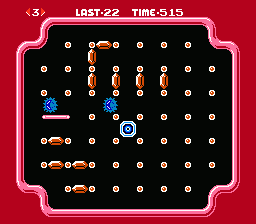
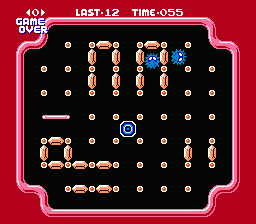
Clu Clu Land

Name: Clu Clu Land
Year: 1985
Publisher: Nintendo
Developer: Nintendo
Genre: Arcade
Hours Played: 4
Beaten: N/A
Imagine being an early NES adopter in 1985.  You're impressed by Super Mario Bros, you buy the system, and now you're ready to get some more games.  Of course, for an entire year there's only sixteen games to choose from.  Excite Bike is a classic, and I personally enjoy Balloon Fight, but past that, what else is there?  Urban Champions?  Ice Climbers?  Golf?  Well, any of them would be infinitely better choices then Clu Clu Land.

I'm just going to say it now: Clu Clu Land is a terrible, terrible game.  At first glance, it's pretty similar in concept to Pac-Man: you constantly move forward through maze in a top-down perspective, outrunning enemies, picking up fruit, and trying to clear the board.  Instead of eating yellow dots, you run over spaces to reveal hidden gems, and when all the gems are uncovered, you've beaten the level.  Their aren't gems in every space, though, so you have to remember where you've already been.  When all the gems are revealed, they form a picture.  This is suppose to help you figure out where the gems you're missing are, but since they didn't bother localizing it, the pictures are often Japanese symbols or letters and thus aren't a whole lot of help.

The biggest deal breaker here is the controls.  In Pac-Man, you hold left to turn left, and the next time he passes a left-facing passageway, he turns.  Not so here.  When you hold left, you're character (no idea what his name is) holds out a hand (flipper?), and the next time you pass a pole, he grabs onto it and swings leftward.  Only, if you don't let go of the button, he continues to rotate.  Ever hit the left button and end up going right?  Because it happens pretty frequently in this game!  But if you do find yourself going in an unexpected direction, don't worry; if you hit a wall, you bounce off and reverse direction!!  The result is you're always flying across the screen in random directions.  You can also shoot a stun beam at your enemies, but I played for over an hour before I ever remembered to do that because I was so busy fighting the controls.  I ended up playing a total of four hours just to get to the point where the levels start repeating (only five levels) and the controls still don't feel natural.

There are some games where the controls are meant to be part of the challenge.  For instance, in Super Monkey Ball, the controls are so precise, you're constantly teetering across narrow ledges trying to not fall off.  In works in that game because whenever you die, you feel like it was your fault, not because you couldn't make the game do what you wanted.  Here, the controls are just a disaster.  It might work in a slow-paced game where you can think about each move, but instead you're constantly moving forward, trying to remember which spaces you haven't moved over yet, and trying to respond to enemies and (here's the worst part) bumpers that appear out of nowhere.  As well as gems, you can also uncover hidden bumpers, which will reverse your direction as soon as they appear.  Having your direction reversed unexpectedly is so much worse then it sounds, because not only do you have to plan every move out in advanced, but the swinging mechanic prevents you from reversing back; you have to either slam into a wall or another bumper, or "circle the block" like you would in a car.

In short, this is possibly the worst game ever put out by Nintendo; the best thing I can say about it is it didn't make me do any math.

Graphics & Animation: 1 (Bad)
I will admit that these are not the worse graphics I've seen on the NES.  The main character and enemies are nicely animated, and the graphics are initially intriguing if only because the enemies and gems bear such a close resemblance to The Legend of Zelda's graphics.  Now, I have no real idea what anything is suppose to be, but I'll save that for story & presentation.

Music & Sounds: (0) Awful
I've had to play this game for several hours to beat the first five levels (they start repeating after that) so I could consider the game "beaten", and sitting here right now, I can't even remember for sure if music plays during the levels.  I think so?  It's very forgettable, is what I'm trying to suggest.

Controls & Level Design: 0 (Awful)
Is there a score lower then zero?  No, seriously, can I make up a score lower then zero, just for the controls in this game?  The controls in this game get a minus one.  There, I did it.

Story & Presentation: 0 (Awful)
This game takes place underwater!  Apparently!  According to some of the websites (Wikipedia, Moby Games) I checked out.  Do you know what would have helped make that clear?  If they'd made the background blue (instead of black) like it is on the box cover!  Also, the main character is some sort of aquatic fish-like creature!  Apparently!  Do you know what would have helped make that clear?  If he didn't have hands, legs, and teeth during the score tallying sequence!

Length & Replayabilitiy: 1 (Bad)
This is one of those arcade-style games that just plays out endlessly, like Pac-Man, so there's not much to say about length.  However, for a game that's about revealing the hidden pictures, they put some randomization in the order the levels appear, so it's not exactly the same each time you play it.  It's a nice touch, but not enough to save the fact you'd never want to replay this.

Total: 2 (Awful)

Friday, December 4, 2015

The Legend of Zelda

Name: The Legend of Zelda
Year: 1986
Publisher: Nintendo
Developer: Nintendo
Genre: Action Adventure
Hours Played: Countless
Beaten: Yes, countless times
Nowadays, the story behind Miyamoto's inspiration for The Legend of Zelda is well known - he wanted to recreate the feelings of exploration and discovery he had when exploring mountainsides and caves near his home as a boy - but when I first read this in the early 2000s, it made complete sense to me.  Gamers today complain about the game's cryptic nature (made seemingly more antiquated by the tutorials and hand-holding nature of so many modern games), but The Legend of Zelda was designed as a mystery for players to slowly unravel.  To this day, it's the only game series I know that marks the occasion (with a special sound effect) whenever the player uncovers a secret - not an item or a tool, but an entrance or passageway that was previously hidden.  It creates a sense of exploration that makes you want to keep scouring Hyrule and plump it's hidden depths.

If I had to use one word to describe The Legend of Zelda, it would be "immersive".  To the casual passer-by, the graphics aren't overly impressive - certainly not the game you'd use to show off the prowess of the NES.  But pick up the controller for five minutes, and the game's rich atmosphere sucks you in.  While complaints about the game's cryptically aren't completely invalid (especially in the second quest), if you're attentive you'll notice the subtly placed clues and the paths designed to lead the player in a particular direction.  It's a testament to amazing level design that the game starts you off in the middle of a maze, and yet most players stumble across the entrance to the first dungeon in their first five minutes of playing.

The Zelda franchinse has went in a lot of different directions since it's debute in 1986.  Some games are more puzzle heavy, some more story heavy; few of them retain the emphasis on combat from the early games.  Every gamer has their opinion on what a Zelda game "should" be like.  But if you're willing to put aside your preconceptions and give it a chance, you'll find a game that still holds up after thirty years.

Graphics & Animation: 3 (Good)
The graphics in Legend of Zelda are iconic, and everything is nicely detailed. A lot of creativity went into the game's enemies and bosses - you won't be fighting rats and crows here.

Music & Sounds: 4 (Excellent)
Zelda games still use the overworld theme from this game today, thirty years later - that's how memorable and iconic it is.  The hits and deflection sound effects all sound just right, and the jingles that play when you find an item or uncover a secret are just as memorable as the theme song.

Controls & Level Design: 4 (Excellent)
People who cut their teeth on Link To The Past tend not to think too much of the original Zelda's controls, but I disagree.  Link (and most enemies) move only in the four cardinal directions, no diagonals, and the game's combat is built around this; for instance, standing around a corner waiting for the enemy to waltz past.  It always gives me the impression of grid-style combat with tabletop miniatures, only in real time.

Story & Presentation: 3 (Good)
When the game first loads up, there's a text-only cut scene (including a cool day-to-night transition on the title screen) which brings you up to speed on the story, and a list of all the items you'll find on your adventure.  At the end of the game, there's the awesome (albeit brief) Ganon death sequence and a cut scene epilogue.  It's all great; but unfortunately that's all the story you'll get.  Zelda II found a way to give you bits of backstory through townspeople dialog and location names (such as the destroyed and relocated town of Kasuto), but there's not much of that here.

Length & Replayabilitiy: 4 (Excellent)
So much to do in this game! Legend of Zelda is already one of the longer games on the NES, with all the secrets to uncover and dungeons to explore, and then once you've completed the game, there's a second quest with remixed dungeons and rearranged overworld locations.  All in all, this game will keep you coming back for a long time.

Total: 18 (Excellent)

Saturday, November 21, 2015

Duck Hunt

Name: Duck Hunt
Year: 1985
Publisher: Nintendo
Developer: Nintendo
Genre: Light Gun
Hours Played: Countless
Beaten: N/A
Duck Hunt was originally released in 1985 as one of the 17 original "black box" games for the Nintendo Entertainment System.  Whether or not it came free with your NES depends on which NES bundle you got; in 1987, Nintendo introduced it's most famous bundle, which featured Super Mario Bros. and Duck Hunt on the same cartridge.  The game mostly served as a demo to show off the capabilities of the Light Gun accessory (a gun control you could point and shoot at the screen).  When you view it as a free mini-game that comes with Super Mario Bros, it's a fun little extra, but when you consider it as a full game on it's own cartridge, it's a little lacking.

There's three games to pick from in Duck Hunt: "1 Duck", "2 Ducks", and "Clay Shooting".  "2 Ducks" is the mode most people thing of when they think of Duck Hunt.  Two ducks fly around a static screen, and you have a few seconds (and three shots) to take them out.  Your trusty hunting dog pop out of the grass holding the number (one or two) of ducks you shot; if you missed both, he giggles at you instead.

"1 Duck" looks and plays almost identically to "2 Ducks", the biggest difference being that you get three shots to take down a single duck at a time.  For some reason, this mode has a special screen every time you miss - the sky goes pink and the words FLY AWAY appear on the screen.  I was never sure why Nintendo thought that was necessarily.  "1 Duck" also includes a little-known two-player mode; the second player uses the standard NES controller plugged into port 1 to (theoretically) control the duck.  The problem is, the duck flies very fast, and the second it hits the edge of the screen the duck switches back to auto, so it's almost impossible to actually exert much control.

"Clay Shooting" is probably the most interesting of the three modes.  Clay pigeons are launched over a field, two at a time, and (like "2 Ducks") you have three shots to take them down.  The reason I always preferred this mode is because the scoring system is more intelligent; how far away the pigeons are and how fast you take them out affects scoring, which adds an element of strategy to the game.  Do you take your time getting a bead but sacrifice points, or shoot them right away and risk missing?

Many games who grew up with the NES have fond memories of Duck Hunt; especially non-gamers (often sisters) who grew up with gamers will often site it as their favorite NES game.  But, though it might have made a great free extra to show off the capabilities of the NES, it's hard to justify spending fifty dollars for this game all by itself.

Graphics & Animation: 3 (Good)
Duck Hunt has very iconic graphics; there's hardly a gamer who grew up in the eighties who doesn't have vivid memories of being laughed at by the hunting dog.

Music & Sounds: 3 (Good)
There's only a couple of short jingles in Duck Hunt, but they're catchy and memorable.  The bigger star here is the sound effects; the duck quacks and the gun shots sound just right, and the laugh of the hunting dog still haunts many a gamer's nightmare.

Controls & Level Design: 2 (Average)
The light gun controls reasonably well; it has a functional sight so you can track your targets.  It's not compatible on all TVs, though.  If your having a hankering to go by an NES at Good Will so you can relieve your childhood, don't expect the Light Gun to work with your modern flat screen TV.  Also, it's a nitpick since no one remembers two player mode anyways, but the controls for the duck are abysmal.

Story & Presentation: 1 (Bad)
The presentation feels a little sparse here.  The title screen and menu are particularly uninspired.  The little cut scene of the dog sniffing are nice, but nothing similar was including for clay pigeon mode.

Length & Replayability: 1 (Bad)
Duck Hunt was a great game to break out when you had friends over who didn't own a Nintendo.  But other then that, how often did you honestly play Duck Hunt?

Total: 10 (Average)

Dr. Mario

Name: Dr. Mario
Year: 1991
Publisher: Nintendo
Developer: Nintendo
Genre: Abstract Puzzler
Hours Played: Countless
Beaten: No, watched video
Nowadays, when people talk about "puzzle games" (what I refer to on this site as "abstract puzzlers), they're referring to games like Tetris or Candy Crush, where you're tasked with arranging colors or shapes into like groups.  What sets these games apart from true puzzle games (games where you're solving actual puzzles) is the random factor: true puzzle games tend to feature puzzles created by programmers with a set solution, where abstract puzzlers tend to focus on dealing with random elements.

Dr. Mario is an abstract puzzler in the column-matching subgenre; pairs of colored objects fall from the sky (in this case, medicine pills with two segments), and it's your job to arrange them into columns or rows of four to clear them.  The twist to Dr. Mario is that at the start of every level, there are "pieces" (in this case, cartoon viruses) already on the playing field, and using the pills to clear them takes you to the next level.

The problem here is the game never quite "clicks".  It doesn't work as an abstract puzzler, because the game is focused on clearing stages and proceeding to the next level; you're never able to get into the groove or trance that comes from endless games like Tetris.  And it doesn't work as a traditional puzzle solving game, because the puzzles you're given to solve (clearing each board) are randomly generated, so they're never that interesting.  Candy Crush managed to take the endless puzzle play of games like Bejeweled and turn it into completing levels, but they did so by giving each level a unique twist: a specific board shape, chocolates to clear, ingredients to collect, etc. In Dr. Mario, the only variation from level to level is the amount of viruses to clear, and it gets old fast.

There were a lot of attempts at column-matching games in the late eighties/early nineties; most of the unsuccessful ones (Hatris, Columns, Yoshi) now languish in obscurity.  Dr. Mario, for some reason, has managed to stick around as a game people remember liking.  Maybe it's the colorful graphics.  Maybe it's the amazingly catchy music.  Maybe it's just because it features Mario in doctor cosplay.  Whatever the reason may be, Dr. Mario is definitely one game not as good as you remember.

Graphics & Animation: 2 (Average)
The graphics are pretty good in Dr. Mario.  The sprites are oversized and colorful.  Three viruses (one for each color in the game) march in the bottom right of the screen, and everytime you make a match, the corosponding virus takes "damage" (falls down and wiggles his legs).  It's an extra touch that adds a lot of charm.

Music & Sound: 4 (Excellent)
The music in Dr. Mario is some of the best on the NES, and second only to the classic Tetris theme in terms of best music in a puzzle game.  It's pretty well remembered by NES fans, and I'm betting it's the main reason behind why Dr. Mario is remembered so fondly.

Story & Presentation: 3 (Good)
Dr Mario has a pretty nice presentation.  Besides the obvious doctor theme, there's also a nice checkerboard theme that's found on every screen in the game.  Non-nonsensical cutscenes play when you beat certain stages, and the game has an "ending" (another non-nonsensical cutscene) that differs depending on what speed you beat the game on.

Controls & Level Design: 1 (Bad)
The controls here have that Nintendo polish to them: pills always land where you intended them to, and there's a lot of room for finesse (slipping pills into tight corners).  The problem here is the level design, or more specifically the space you're given to work with.  Go ahead and set the game on a higher level, then tell me if you feel like it's a reasonable challenge to clear the viruses with the amount of space given; on level twenty (the final level), a single mistake can cost you the game.  That would be fine if there was no time limit, a la Candy Crush, but on the higher levels you only have a second or two to place each piece!

Length & Replayability: 0 (Awful)
The bottom line is that Dr. Mario feels like a chore to play.  Having a mode with pre-designed (not random) virus configurations could have went a long way to making this game more playable.

Total: 10 (Average)

Sunday, November 15, 2015

Yoshi

Name: Yoshi
Year: 1991
Publisher: Nintendo
Developer: Game Freak
Genre: Abstract Puzzler
Hours Played: Countless
Beaten: N/A
I hadn't played this game since I was a kid, and I remembered it being decent but forgettable; no Tetris, but better then Dr. Mario.  Well, I'd like to apologize to the good doctor, because this game is absolutely terrible.

The idea is simple: you have only four columns in which to arrange four types of famous Mario enemies (Boos, Bloopers, Goombas, Piranha). Two stacked on each other makes a match.  The gimmick is there's also top and bottom halves of Yoshi eggs.  Line up a top and bottom, and a Yoshi hatches for extra points.  Stack enemies between the two halves and you get even more.

The first problem is, for a game in the vein of Columns, the gameplay is pretty boring.  Only having four columns to maneuver in adds some challenge, but only needing two characters to make a match means you can clear out the well pretty fast.  The egg hatching mechanic doesn't add much to the game; I tried playing once where I made the biggest combos possible, and a second time where I completely ignoring the eggs.  My level was higher in the second game, but my score was almost identical.

The second and much bigger problem is the game's AI.  There was a fad in the nineties to make video games "intelligent", meaning the game adjusted the difficulty during play to meet your skill level.  That sounds pretty cool in theory, but what it usually translated into is you'd start to do really well and then the game would throw a ton of crap at you to take you out.  It always came off as unfair, and it was the predecessor of the "forced fair" tactics still found in Mario Kart and Mario Party games today.  Yoshi makes heavy use of this tactic; if you're doing too well, the game will temporarily speed up and increase the number of falling enemies, as if to say "here, deal with this!"  Since there's four columns and four enemies types, the biggest annoyance is getting two enemies of the same type at once.  So when the game decides to start throwing trios of the same enemy at speeds too fast to react to, it kind of feels like getting the finger for doing too well.

The bottom line is that Yoshi feels like a chore to play.  Five minutes of boring, too-easy gameplay, followed by thirty seconds of unfairly challenging gameplay, does not equal a good game.  It's hard to believe in today's oversaturated world of mobile puzzle games, but in the nineties everyone was still desperately trying to create the next Tetris and no one quite knew how to pull it off.  This is definitely one of the weaker attempts.

Graphics & Animation: 2 (Average)
The best thing about this game is the graphics.  The Mario enemies present have never looked better, and it's the first time we ever saw Yoshi (the character) on the NES.

Music & Sound: 1 (Bad)
Remember how Dr. Mario was an average, kind of boring game, but they still gave it fantastic music that sticks with you way afterwards?  Yeah, not so much here.  I've been playing the game all day and I can't even hum you a note.

Controls & Level Design: 0 (Bad)
Instead of controlling the falling enemies directly, you shuffle the board around from below, giving you pretty precise control of where you want things to land.  That's good controls.  Bad controls is getting slammed with six or seven waves of enemies because it's impossible to place them in time.  Either change the controls or change the speed, but stop punishing me for making progress!

Story & Presentation: 1 (Bad)
Remember in Yoshi's Cookie for the NES, how they tried to give the game personality by making it look like a bakery and having Mario in a chef's outfit?  Yeah, there's nothing like that here.  The menus look exactly like the ones in Dr. Mario or Tetris... it's just very uninspired.  There are at least cut scenes if you play Game Type B... they tell the very exciting story of Yoshi eating a different power-up each time.  Pac-Man had more interesting cutscenes then this.

Length & Replayability: 0 (Awful)
There's not much to do here except play a very poor excuse for a puzzle game.

Total: 4 (Bad)