Showing posts with label Beam Software. Show all posts

Wednesday, February 3, 2016

Battle Chess

Name: Battle Chess
Year: 1990
Publisher: Data East
Developer: Beam Software
Genre: Board Game
Hours Played:
Beaten: No, I suck at chess
Battle Chess was a novelty game for computers and consoles in the late eighties/early nineties.  The concept is simple: it's just standard chess, but when you move, the pieces get up and walk around, and when you capture another piece, you get to watch the two characters fight each other.  The game is loaded with over 100 animations, as every possible paring of pieces has it's own unique battle animations, and the charm of the game comes from the different character's personalities: knights creak and lumber around the board, rooks transform into rock monsters, etc.

Although it's not widley remembered now, Battle Chess was very popular (espicially for PC) and spawned a number of sequels and spinoffs; however, unlike contemperary cult classics like Archon, there doesn't seem to be any indication of a Battle Chess remake or revival or Kickstarter (EDIT: turns out I was wrong).  That's because unfortunately, like all novelties, the novelty of Battle Chess eventually wears off.  The appeal of the game is to show off your hardware to your friends, and see how many different kill animations you can discover; once you've done that, you're left with a pretty standard chess simulation.  If you just want to play chess on your NES, you're better off sticking with Chess Master: it has a teaching mode for beginners and better AI for experts.  But if you want your friends to think you're smart while watching medieval characters kill each other, there's always Battle Chess.

Graphics & Animation: 4 (Excellent)
The animation is the showcase here, and the NES does a pretty good job of mimicking it's PC brethren.  There's over a hundred different battle animations (one for every possible combination of attacker/defender), and each piece has it's own distinct personality.

Music & Sounds: 2 (Average)
This is one case where I don't mind the lack of music during the main game, as true chess players would probably find it a little distracting.  The grunts and groans of the combatants are a nice touch, though.

Controls & Level Design: 1 (Bad)
The game controls just fine (although I wish it had a cancel button), and I can't really fault chess for a lack of level design.  My main complain here is the lack of options; compared to Chess Master, this is a pretty bare-bones representation.

Story & Presentation: 4 (Excellent)
This cartridge may have more cutscenes then any other single NES game, thanks to all the unique battles between the pieces.  The game has a style all of it's own - it's actually pretty violent for an NES game.

Length & Replayabilitiy: 1 (Bad)
Trying to find every combination of pieces will keep you entertained for a little while... but after that, you'd better really like chess.

Total: 12 (Average)

Monday, December 21, 2015

Fisher-Price: Perfect Fit

Name: Fisher Price: Perfect Fit
Year: 1990
Publisher: GameTek
Developer: Beam Software
Genre: Educational
Hours Played: Half an Hour
Beaten: Yes
Like all three NES Fisher-Price games, Perfect Fit began life as a DOS game.  The computer operating system that preceded Windows, DOS was primarily text-based, and while some (but not all) DOS games did have graphics, they tended to be crudely drawn, have a limited color palette, and more often then not they featured either no music, or a public domain soundtrack (i.e. classical music, children's songs, etc).  As was only natural, when the Nintendo Entertainment System gained popularity in the US, a lot of computer companies ported their previously DOS-only games to the NES.  Since the NES was technically superior, these conversions tended to be upgrades: better graphics, real music, etc.  Not so with Fisher Price: Perfect Fit.

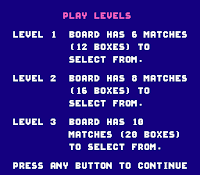
The idea here is that the game gives you one picture at a time, and you have to match that picture to it's outline on a grid.  On easy, you literally just move the picture over it's outline and hit the button.  On the hardest setting, the picture might be backwards or upside down, and there's buttons that let you flip the picture to straighten it out.  That last bit would actually be pretty clever, except with some of the pictures it's a little too subtle; for instance, the only way to tell the Fisher-Price cassette tape is backwards is to look for the FP on the label.  Speaking of which, the Fisher-Price product placement makes a return here, but there's also letters and numbers to place, giving the game a modicum of educational value.

All in all, Perfect Fit is a pretty poor excuse for a game.  Some may question whether it's even worse then Fisher Price: I Can Remember; after all, Memory is a real game that people pay money for, and at least it has some arguable educational value.  To those remarks, I say this: number one, Perfect Fit isn't included as a free mini-game on hundreds of other video games, and number two: while I didn't enjoy playing Perfect Fit, I also didn't fall asleep.  That's faint praise, though; this is still easily one of the worst games on the NES.

Graphics & Animation: 0 (Awful)
Although several of my sources tell me this was originally a DOS game, MobyGames has it listed as NES only.  If that's true, they sure went through a lot of trouble to make this look like shoddy 80's PC shareware.

Music & Sounds: 0 (Awful)
PCs in the eighties only had one sound channel.  The NES had five.  Guess how many this game uses?  Feel like hearing public domain children's song blared at top speed one note at a time?  Then you're in luck!

Controls & Level Design: 1 (Bad)
The whole game is about lining up pictures over their shadows.  Well, you'd better make sure you've lined it up exactly, because if you're off by even a little bit, the game tells you you're wrong.  When you're aiming your game at very small children, this is inexcusable.

Story & Presentation: 0 (Awful)
The best thing I can say about this game is that they got rid of the annoying angry buzzer from I Can Remember.  Sure, navigating the menus is still unintuitive, but at least the game no longer punishes you for not being able to figure it out.

Length & Replayabilitiy: 1 (Bad)
Perfect Fit has a two player mode, a versus the computer mode, a solo mode, and three levels of difficulty.  If this was a five dollar shareware game for PC on the eighties (which I suspect it was), I'd actually be pretty impressed by it.  But as a fifty dollar game for the NES, this is just a mess.

Total: 2 (Awful)

Fisher-Price: I Can Remember

Name: Fisher-Price: I Can Remember
Year: 1990
Publisher: GameTek
Developer: Beam Software
Genre: Educational
Hours Played: Don't know, fell asleep
Beaten: Yes, at least once
When I started this blog, I picked for my first post Color a Dinosaur, because I was confident it would be the worst game I ever reviewed for the NES.  Well folks, I'm only about thirty games in, and I may have found one that's worse.  I've played a lot of bad video games, but I've never in my life found myself nodding off during a game before.

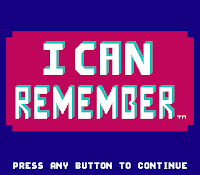
At it's core, I Can Remember is just a game of Memory.  There's a set number of cards on the table, and you take turns flipping over cards two at a time; if the two cards you pick match, they disappear and part of a picture appears below.  Match all the cards, and the entire hidden picture is revealed. Not particularly inspired, but unlike, say, dinosaur coloring, it's at least an actual game you can actually play.  So what exactly is the problem here?

Well first of all,  everything in this game takes forever.  You pick a card, it slowly flips over.  You pick a second card, it slowly flips over.  They don't match?  They slowly flip back.  They do match?  They slowly disappear, and the hidden picture slowly reveals itself.  I literally found myself fighting to stay awake at one point.  Secondly is the pictures themselves: they're all Fisher-Price toys!  You can flip over cards with toy telephones, or ring stacks, and when you reveal the hidden picture, it might be a rocking horse!  All available at your local toy store!  I see people mock games like M.C. Kids for their in-game product placement, but this is about the worst I've seen that wasn't a free game included in a box of cereal; even the Burger King would be embarrassed by this.

But the biggest problem here is just how little effort seems to have went into this.  Seriously, this is the first NES game I've ever played where I've seriously wondered if it was made by one guy.  For instance, if you play on the highest difficulty level, the game deals out twenty cards, and they fill the screen.  So when you pick the easiest setting and it deals only 12 cards, how do you think the developers handle it?  Scale the cards up to fill the screen?  Have blank spaces at the top and bottom?  Nope!  The game still shows twenty cards, but if you try to pick from the top four or bottom four, the game buzzes angrily at you to let you know that you're in the wrong.  Yeah, that's definitely pretty educational!

On a personal note, I dabbled in amateur game design myself for a little while.  I was honestly pretty terrible at it, but even I managed to make a playable Memory game.  Do you know why?  Because Memory is one of the easiest games to program.  Seriously, when you're teaching people how to program games, it's usually the second game you teach, right after "guess a number".  There's a reason why it's such a common mini-game in other games you buy.  For fifty bucks in the nineties, you could buy Super Mario Bros. 3, with a card matching mini-game that's infinity better then this one, AND the entire game of Super Mario Bros. 3 to go with it!  Or, you could pay fifty bucks for an advertisement from Fisher Price.

Graphics & Animation: 0 (Awful)
This game looks terrible.  I had no idea it was possible to replicate CGA graphics on the NES, and I still have no idea why you would want to, but they sure pulled it off!

Music & Sounds: 0 (Awful)
All the music here public domain.  Yeah, unlike Color a Dinosaur, which had you coloring your dinosaurs mostly in silence, there's plenty of music here; you're constantly assaulted with super-loud renditions of Old MacDonald and Twinkle Twinkle Little Star.  And don't even get me started on the awful buzzing sound when you're wrong, or if you just do something the game doesn't like.

Controls & Level Design: 0 (Awful)
Before you're allowed to play, the game forces you to pick a name, even if you're playing by yourself.  You're given a grid of letters, and you pick letters to spell your name.  Now, in most games, hitting left when your cursor is on the left-most side would cause it to jump over to the right-hand side, and making a name of the maximum length would cause the cursor to jump automatically to "done".  Not only does this game not include these small but handy features, but it actually buzzes angrily at you when you try to do them!  There's even a couple of blank spaces the developers left there out of sloppiness, and you get buzzed for trying to pick them, too.  This is the kind of design and controls we're talking about; the game hasn't even started yet, and I'm ready to hurt somebody.

Story & Presentation: 0 (Awful)
This was originally a DOS game, and it's almost impressive how little work they clearly did to move it over to the NES.  It's not that DOS games are terrible by nature, it's just that they're technically inferior to what the NES can offer.  This should have been an upgrade, not a lateral move.

Length & Replayabilitiy: 0 (Awful)
This is the only category I considered giving the same a (single) point in.  Yes, it does have one and two players, play against the computer, and play against yourself, and there are three levels of difficulty, so clearly they put a little effort in, right?  That's until you actually try the different modes and see how little effort was put into each one of them.

Total: 0 (Lowest Possible Score)
Tuesday, December 15, 2015

Sesame Street: 1-2-3

Name: Sesame Street: 1-2-3
Year: 1989
Publisher: Hi-Tech Expressions
Developer: Beam Software
Genre: Educational
Hours Played: 2
Beaten: N/A
In 1989, Hi-Tech Expressions released two collections of old DOS Sesame Street educational games packaged as two-packs for the NES.  One was Sesame Street A-B-C, which taught letters, and the other one is Sesame Street 1-2-3, which teaches math, shapes, and colors.  In this review we'll be looking at the latter.

The first game, Ernie's Magic Shapes, is about shape and color matching.  A shape appears over Ernie's head, and a second one appears over his magic hat.  Hitting the direction pad cycle through different options (it doesn't matter what direction you push, but given the game is aimed at three year olds, that's understandable), and when you find a shape of matching size and color, you hit A or B.  If you get it right, a bunny pops out from the hat and celebrates; if you get it wrong, he shakes his head at you.  There's quite a few game modes, from a tutorial, to matching only colors, only shapes, both, or picking from multiple shapes to create a picture.

The second game, Astro-Grover, is geared towards counting and math.  The idea is there's little aliens, called Zips, and you have to match the number of Zips shown on the screen.  There's multiple game modes, and they all play differently; in one you count the Zips then pick the right number, in another you're given a number and must pick the group of Zips that equals the right amount.  In the more difficult modes, you add and subtract; unlike Mickey's Adventure in Numberland, which presents you with a math problem and then acts like it taught you something, in Astro-Grover the problems are always illustrated with Zips; even if you can't work the problem yourself, you can still count the Zips on screen and get the right answer.  This is a pretty effective way to teach the basic concepts of mathematics.

I gave Sesame Street A-B-C a pretty hard time in it's review, suggesting that Letter-Go-Round did a poor job of teaching reading, and that Ernie's Big Splash didn't teach much of anything.  This game is a much better effort, and definitely one of the more educational games for the NES.  If this were the early Nineties and I was buying a game for my four-year-old, this is probably the game I'd go with.

Graphics & Animation: 3 (Good)
Like Sesame Street A-B-C, they definitely put more effort into the graphics then they really had to.  Ernie's Magic Shapes takes place at a magic show, complete with stage and curtains.  There's two screens for Astro-Grover, one involving a night sky over a neighborhood with an onlooking moon.  Astro-Grover in particular seems to have a lot of effort put into the animation; unfortunately they slow the game down, as you're not allowed to keep playing until things are done moving around.

Music & Sounds: 1 (Bad)
The songs here are pleasant enough, if forgettable.  There's no jingle or sound effect to tell you when you're wrong, though, and I miss the Sesame Street theme that was so lovingly recreated in Sesame Street A-B-C.

Controls & Level Design: 2 (Average)
The controls are simple enough for little kids.  It's funny how in most places, which button you hit on the D-pad doesn't matter, but in a couple of the Astro-Grover games, it doesn't.  I won't fault that though, as I feel like the games that utilize it are aimed at slightly older kids then the rest.  While Ernie's Magic Shapes feels like one game with several different modes, the modes in Astro-Grover are varied enough to legitimately feel like several different games, which is nice.

Story & Presentation: 2 (Average)
As with the graphics, the presentation here has more effort put into it then was strictly necessary.  Little touches like the rabbit, moon, or Grover shaking their head when you get things wrong go a long way towards selling the game.

Length & Replayabilitiy: 3 (Good)
Sesame Street 1-2-3 has an impressive amount of modes for different skill levels.  Between shapes, colors, counting, and simple mathematics, there's a lot to learn here, and unlike most "educational" games for the NES, I feel like someone actually had some kids play and test these games to make sure they were effective.  Astro-Grover may be no Math Blaster, but he's the best the NES has to offer.

Total: 11 (Average)

Tuesday, December 1, 2015

Mickey's Adventure in Numberland

Name: Mickey's Adventure in Numberland
Year: 1994
Publisher: Hi-Tech Expressions
Developer: Beam Software
Genre: Educational
Hours Played: Countless
Beaten: Yes, Many Times
Near the end of the NES's life, Hi-Tech Expressions released two Mickey Mouse themed educational games.  The second game, Mickey's Adventure in Numberland, came out one year after it's predecessor (Mickey's Safari in Letterland), and it shows.  The two games play very similarly, but Numberland builds upon the the first game in many ways.

The game begins with a map with four areas: City, Museum, Observatory, and Factory.  Each area has two levels (although you're returned to the map screen each time you clear one, meaning you need to visit each area twice).  Clear all four, and you open up the final area, Pete's Hideout.  Gone is the world-spanning safari theme of the last game; here, the levels have a very urban feel, and Mickey is dressed in sportswear.  He even has a basketball he fiddles with during his idle animations.

Your objective in each level is to collect a specific number.  Incorrect numbers are sprinkled throughout the level, and Mickey shakes his head disapprovingly if you try to grab the wrong one.  There's bubblegum to collect that you can shoot at the enemies, and you actually have a life meter this time around, making the stakes a little higher (for a game aimed at very young children).  The coolest thing in the levels are the blackboards; they cycle through numbers, and if you land on them when they're displaying the number you're looking for, you get a bonus point.  It's completely optional, but it actually involves a little skill (something rarely seen in edutainment titles).

All in all, Mickey's Adventure in Numberland feels a lot more like a bonafide platformer then it's predecessor.  Sure, it's easy, and a seasoned gamer can beat it in about ten to fifteen minutes, but at least it requires a little skilll, especially when you crank up the difficulty and go for all the bonuses.  The downside to this game is that I'm not sure it really succeeds at being that educational.  There's a single digit addition or subtraction problem at the end of each stage, but the game does nothing to teach you how to work the problem.  Sesame Street: Countdown may be a terrible game, but at least you have to collect the right number of items, instead of just the number.

Graphics & Animation: 3 (Good)
The graphics here are big and colorful.  Your child will instantly recognize Mickey, Donald, and Pete.  Mickey himself has a lot of different animations, including playing with a basketball while waiting for you to hit a button.

Music & Sounds: 4 (Excellent)
Mickey talks!  I said this with the last game, but it still applies here: this was very impressive for the time, and still holds up pretty well today.  Sound bites take up a ton of cartridge space, but they managed to squeeze quite a few clips in.

Controls & Level Design: 2 (Average)
The addition of an attack (and the ability to take damage) add a lot more depth to this outing.  The levels here are longer, but shorter; sadly, gone are the secret passages of the first game's Egypt levels.  You still have to explore the levels pretty thoroughly to find everything, though.

Story & Presentation: 3 (Good)
The story and presentation is the one clear step up in this game.  We now get an opening cut scene showing Pete stealing all the letters, and Mickey and Donald pop up with full screen portraits to give messages to the player.

Length & Replayability: 3 (Average)
This game is shorter then it's predecessor, but I feel like it will entertain you for a little longer.  The levels are longer and more interesting (even though there's only ten of them as opposed to the last game's twenty-six), and there's still three levels of difficulty.  I can also see an older sibling playing this game through at least once (I certainly did with my little brother's copy, back in the day), whereas Letterland would bore any older kid pretty quickly.

Total: 16 (Good)

Friday, November 27, 2015

Mickey's Safari in Letterland

Name: Mickey's Safari in Letterland
Year; 1993
Publisher: Hi-Tech Expressions
Developer: Beam Software
Genre: Educational
Hours Played: One
Beaten: Yes, without cheats
Mickey's Safari in Letterland, and it's sequel Mickey's Adventures in Numberland, are two of the better "edutainment" (educational entertainment) games to come out for the NES.  Both games teach a general concept to kids (in this case, letters) while still playing like a simple low-stress platformer.

Letterland looks suspiciously like a world map.  Mickey picks one of six locations, some of them real places (Yukon, Egypt) and some hilariously non-specific (Forest, Swamp).  You play a short platforming level, and then it's back to the map.  You're meant to play each location several times, traversing a different "stage" of that location each time, but the game doesn't communicate this very well.  Once you've beaten every stage in a given location, it's picture is replaced with a Mickey face, and once every location is completed, the game is over.  No final level here.

The stages themselves are pretty short.  The main goal is getting to the stolen letter at the end, but there's also three letter gems on each board that, when collected, spell a word. Mickey lacks an attack, but the enemies only stun you for a couple seconds anyways; you can't die in this game.  Mickey does have a butterfly net he can swing, but it's only used for picking up letters;  I wish they'd left it out and just let you pick things up by touching them.  Some of the areas are much more difficult then others (slippery slopes in the Yukon, hidden passages in Egypt), but there's nothing on the map screen to suggest this; in fact the cursor defaults to Yukon, which is one of the more difficult levels, instead of starting over an easier location like Forest.

All in all, Mickey's Adventures in Numberland is a better game, but I feel like Mickey's Safari in Letterland is more educational.  My three-year-old sat on my lap while I played this, and he had a blast spelling the words out with Mickey.  Unlike Numberland, which is basically a platformer with a couple math problems thrown in, I can see how a few rounds with this game could actually help him learn to read.  Definitely the best educational game on the NES I've played so far.

Graphics & Animation: 3 (Good)
I'm well aware I'm going to get made fun of for giving Mickey's Safari in Letterland such a high overall score, but darn it if this game doesn't have some of the best graphics and sounds on the NES!  There's cameos by plenty of different Disney characters, and they're all rendered in colorful oversized sprites.  Now, I could argue all day why the sprite size in Ducktales fits the style of gameplay better, but when it comes to which one you're toddler will instantly recognize and identify with (and yes, I tested this), it's this game.

Music & Sounds: 4 (Excellent)
Mickey talks!  This might not sound particularly impressive in today's age of branching dialog trees, but it was pretty impressive back in the days of the NES.  You and I  as adults may not be particularly thrilled to hear Mickey's high-pitched chirpy exclamations, but let's face it; we're not this game's target audience.  My three-year-old, on the other hand, loved every second of it.  And I have to admit, it definitely sounds like Mickey.

Controls & Level Design: 2 (Average)
The controls and level design are definitely skewed towards younger gamers, but it still plays like a platformer, meaning you still have to land jumps.  This is where I'm torn; while the gamer in me wishes it were a little harder, the parent in me thinks this would be way too difficult for someone who's actually still learning the alphabet, as the game assumes.  I doubt this is what the game designers intended, but it's probably best played exactly the way we played it: daddy at controls, toddler in lap.

Story & Presentation: 3 (Good)
Did I mention the graphics?  Everything here is bright and colorful, and even the menu screens are bursting with personality.

Length & Replayability: 3 (Average)
This game has a surprising amount of stages of a game of it's ilk (26, one for each letter of the alphabet!).  It also has three difficulty levels that nicely tailor the game to your little one's skill level.  It may not entertain older gamers for long, but for a younger gamer, you could do a lot worse...

Total: 15 (Good)