Showing posts with label Capcom. Show all posts

Wednesday, January 27, 2016

Mega Man 4

Name: Mega Man 4
Year: 1991
Publisher: Capcom
Developer: Capcom
Genre: Platformer
Hours Played: Countless
Beaten: Yes, without cheats
Mega Man 4 is often regarded as one of the "bad" Mega Man games - generally placing just after 6 and 1 in terms of people's general dislike for it.  Yet it doesn't have the unforgiving difficulty of the first game, or the poor level design of the sixth game, or even the odd control quirks of the third.  So why the poor reputation?

The answer is because, for better or worse, Mega Man 4 marks the point that the series became paint by numbers.  After the careful fine tuning of 2 and the unique storytelling chops of 3, the rest of the series from here on out would follow a careful formula: an opening cut scene introduces a new villain, Mega Man beats all 8 robot masters, tackles the new villain's castle and beats him, Dr. Wiley is revealed to be behind it, Mega Man tackles an all new Skull Castle and beats Dr. Wily. Again. Rinse and repeat.

You may be tempted to give Mega Man 4 a pass for this - after all, it's the first game to use this formula, right? (Assuming you don't count Dr. Wily's "surprise" betrayal in 3) But even here, it feels like the developers were more interested in trying to remake Mega Man 2 then they were in innovating.  Once again we have a water-theme villain (which until this point was only seen in MM2), a villain who shoots fire (1 and 2), an earth-theme villain (okay to be fair I think they all have one of those)... heck, with Bright Man they literally reused Flash Man's weapon and didn't even bother renaming it.  The last stage of the game also seems extremely familiar to those who've beaten Mega Man 2, right down to entering a dark room for the final boss, and having the lights come on in a lab when the fight's over.

The most controversial addition, however, is the Mega Buster, Mega Man's new default weapon. By holding the fire button for a few seconds, Mega Man can release a larger, more powerful shot.  This addition appeared in all the subsequent Mega Man games, and even other series, such as Mega Man X. Many fans feel this made the game "too easy" or took the emphasis off acquiring the bosses' weapons.  Is this true?  Well, yes and no.  Your standard weapon IS more powerful, not because of the charge shot (which only does x3 the damage of a normal bullet) but because the game no longer restricts you to only shooting three shots at a time.  Why even bother with the charge shot when you can pump an endless barrage of bullets into your enemy?  As for using the boss weapons, the issue is that Capcom greatly reduced the amount of damage that Robot Masters take from the the weapon their "weak" to, meaning their's less point in figuring out the correct weapon to use.  The result of all this is the easiest levels but hardest robot masters (and hardest boss rush) in the series up to this point.

All that being said, I would by no means call Mega Man 4 a bad game.  The music, while not as memorable as 2 or 3, is still leaps and bounds over most music on the NES, and the graphics are actually better then ever.  Mega Man 4 boasts the best opening cutscene (the only time we see Mega Man's origin recounted), the best "weapon get" screen, and the most colorful minibosses of the entire series.  There's even a couple moments of innovation: hearkening back  to the original Mega Man, there's two "adapter" items (one is a grappling hook, the other is Item 1 from MM2), and they're hidden in the robot master stages; finding them actually takes a little creative thinking, which I really enjoyed.

Graphics & Animation: 4 (Excellent)
Capcom was clearly trying to outdo themselves in the graphics department, and they succeeded: the over-sized cartoony enemies from three are even bigger and cartoonier here, there's more giant mini-bosses then ever, and the cutscenes (including the "get weapon" scenes) are the best in the series.  You'd be hard pressed to find a better looking game on the NES.

Music & Sounds: 3 (Good)
There's not as many "get stuck in your head and stay there forever" songs in this game as their are in the previous entries, but there's still some good ones (even years later, I can hum you Skull Man's music), and once again the sheer amount of different tunes in a single NES cartridge is impressive all on it's own.

Controls & Level Design: 3 (Good)
The controls here are tight, and for the first time ever, Mega Man doesn't fall off ladders if you pause and unpause the game.  In older games, Mega Man couldn't have more then three bullets on the screen at once, due to technical limitations of the NES; here, they resolved that problem, but didn't tweak the difficulty to account for it, meaning you can spam the fire button in a way not possible before.  The levels are a little lackluster as well, relying too heavily on minibosses then before - Ring Man's level stands out as an especially egregious example, with four minibosses and only a handful of obstacles otherwise.

Story & Presentation: 4 (Excellent)
Regardless of what everyone else at Capcom were doing, the art department was clearly under the impression they were working on the greatest Mega Man game ever, because everything in the presentation and cutscenes shines here.  While the opening cutscenes in the next two games would focus on setting up plot and red herring villians, the intro here is all about Mega Man himself, and gives us the more characterization about him then the other five games combined.

Length & Replayabilitiy: 3 (Good)
Technically the longest Mega Man game to date, but definitely not as replayable as some of the others.  The hidden items do add a little replayability to the game, though.

Total: 17 (Good)

Wednesday, January 6, 2016

Mega Man 3

Name: Mega Man 3
Year: 1990
Publisher: Capcom
Developer: Capcom
Genre: Platformer
Hours Played: Countless
Beaten: Yes, without cheats
Mega Man 3 is easily the second most popular game in the series; discuss how great Mega Man 2 is anywhere on the internet, and fans will always come out of the woodwork to tell you they prefer the third game.  This devotion comes not because Mega Man 3 is the most polished of the series, but because of it's atmosphere and storytelling techniques.

The overall theme of Mega Man 3 seems to be "mystery".  There's question mark containers sprinkled throughout levels with random contents.  After beating the eight levels, four of the areas are seized by mysterious robots, and selecting one causes a question mark to appear where a robot master would normally introduce themselves.  Most mysterious of all is a new character, similar to Mega Man but red, who appears in various levels, sometimes as a miniboss and sometimes to help you out.  The most innovative and memorable thing about Mega Man 3 is the way the game reveals who this character is and why he's important without using a lot of dialog or backstory; it pushes you to keep playing the game to find out more about him.

While the sub-plot about the mysterious robot is beautifully told, the game's main plot is a confusing mess.  The game starts out with a melodic song where their clearly should have been an opening cinematic scene explaining the story thus far, but there isn't one.  Dr. Light shows up halfway to deliver the shocking twist that Dr. Wily (series antagonist) has turned evil - was that suppose to be a surprise?  Apparently according to the manual, the plot is that Dr. Wily has renounced his evil ways and was working on a peace-keeping robot (called Gama) with Dr. Light.  So the idea is that the eight different levels take place on different mining planets (I guess), each headed up by a robot master who's went berserk, and you have to defeat the robots to get the elements that Wily and Light need for Gama?  I think?  Except the robots are berserk because Dr. Wily has taken control of them, except he still can't use them to get the elements himself?  For some reason?

The levels in this game are a hodgepodge.  Staring with Mega Man 2, Capcom would hold contests in Japan to allow people to design robot masters, and then they'd use those designs in the games.  The result of this is sometimes having a robot master who is seemingly unrelated to the level they rule over, such as Flash Man's ice level in Mega Man 2.  In most Mega Man games, this really only happens for one or two stages, but here it feels like most of the levels and their bosses were paired up randomly.  Shadow Man has a fire level, Top Man rules over a greenhouse, Gemini Man rules an ice and water level... but then on the other hand you have Snake Man, who's level is so on the nose (the level is literally made out of robot snakes) that it's probably the most over-the-top level in the whole series.

Series creator Keiji Inafune has stated that after the runaway success of Mega Man 2, Mega Man 3 was rushed to production; unfortunately, the final product shows.  The fine-tuning and polish from the last game are missing here.  New items (the Rush Jet and Rush Marine) are poorly implemented, and the controls are sloppy (for a Mega Man game).   The game will always hold a special place in many gamer's hearts (including myself) for teaching us that a game could convey a story through gameplay rather then exposition, but after the perfection of Mega Man 2, it comes off as just a little bit of a disappointment.

Graphics & Animation: 4 (Excellent)
This was the game in the series that really cemented the oversized enemy sprites.  In Mega Man 2, you saw them with minibosses, but here, just regular enemies that used to be 16x16 sprites have been redrawn to be 32x32.  It gives the whole game a super colorful, super cartoony look.  You can argue that it also makes the enemies a little less menacing then they were in Mega Man 2, but they have so much personality that it's hard to complain.

Music & Sounds: 4 (Excellent)
The music here is once again incredible; the opening theme in particular, both moody and melodic, is some of the best in the entire series.

Controls & Level Design: 3 (Good)
The controls here are still good, but just not quite up to the par set by the other games in the series.  Until Mega Man 4, Capcom built a new game engine from scratch for each new Mega Man game, and Mega Man 3's has some funny quirks.  You're unable to pause the game and access the menu if any of your bullets are still on-screen, and this can cause some serious problems, especially if you've fired the Gemini lazer (which can bounce around the boss room quite a bit before disappearing) and you need to access an energy tank.  Likewise, the level design is also good, but feels just a little rushed.  There's never any areas where the Rush Marine can be used to it's full potential, and there's a Rush Jet-heavy level where dying in the middle basically means you're screwed; having the weapon refills reappear would have really made things simpler here.

Story & Presentation: 3 (Good)
The presentation here is good, don't get me wrong, but I really miss the opening cut scenes that all the other Mega Man games (except the first one) have.  The sub plot about the mysterious Proto Man is very cleverly told through game play, but the game's main plot baffles me.

Length & Replayabilitiy: 3 (Good)
Mega Man 3 has four more levels then it's predecessor, giving the game an impressive length for an NES platformer.  Still, the lack of polish (Mega Man 3 is infamous among perfectionists as the only game in the series where it's impossible to beat the game without taking a hit, due to a couple of undodgeable boss attacks) and no difficulty setting make it a little less enduring then it's predecessor.  Mega Man 2 was a game you couldn't wait to beat again and see if you could do better; Mega Man 3 was a game you couldn't wait to finish, see how the story came out, and then be done.

Total: 17 (Good)

Tuesday, December 15, 2015

Mega Man 2

Name: Mega Man 2
Year: 1988
Publisher: Capcom
Developer: Capcom
Genre: Platformer
Hours Played: Countless
Beaten: Countless times
Mega Man 2 is widely regarded, by critics, fans, and even it's creator, as the best game in the series.  To a modern audience, it may be hard to see why - "you can't even shoot up!", you may complain - but for old school video game fans, this is action platforming distilled down to it's essence.

Everything in Mega Man 2 is about precision.  You can only shoot forward, but your bullets travel the entire length of the screen, meaning that as long as you've lined up and timed your shot correctly, you're going to hit it.  There's a lot of tricky jumps, but unlike Super Mario Bros, Mega Man has no acceleration - jumping from a standstill is the same as jumping from a run.  This is crucial for platforms that appear and disappear at a moment's notice.  Running to the right as fast as possible is never the best strategy - the game rewards you for thinking about the enemy's patterns and plotting out the best strategy.

As with other games in the Mega Man series, the first eight levels can be played in any order.  The first eight levels are each dominated by a "robot master" (level boss), and everything in the level is themed around them (e.g. Air Man's level is set in the clouds, full of moving platforms, and patrolled by robot birds).  Although you can beat the levels in any order. besting a robot master grants you use of their weapon, and since different enemies are weaker to certain weapons, it adds a layer of strategy to what order you tackle the levels in.  After all eight levels are completed, Mega Man faces Dr. Wily's multi-leveled Skull Castle, where the disparate elements from different levels (as well as a couple new things) all come together to create the ultimate challenge.  It gives you the sensation that the game has been testing you and preparing you for the battles that lie ahead.

To say that Mega Man 2 was and remains one of the most popular NES games is an understatement.  The game has inspired cartoons, comic books, fan games, original songs, and even laments on how hard it is.  If you're a fan of jumping, shooting, and walking to the right, and you want to see just how far those three simple concepts can be stretched, this is the game to play.

Graphics & Animation: 4 (Excellent)
The graphics are superb; everything is bubbling with creativity.  In the last game, the enemy robots looked like robots built with specific functions in mind.  Here, it's the exact opposite; you'll fight robotic frogs, monkeys, prawns, baby chicks, and so much more.  The design team does a great job of taking something from nature and then adding bolts and joints in just the right place so you can still tell it's a robot.

Music & Sounds: 4 (Excellent)
Mega Man 2 is famous for having some of the best music in gaming, let alone for the NES.  Like all Mega Man games, every level has it's own music, and almost all of them are unforgettable.  The music alone has inspired everything from remixed music to rock covers with original lyrics to original songs with original lyrics about the game.

Controls & Level Design: 4 (Excellent)
The level design here is the strongest in the series.  The developers have this uncanny knack for introducing a new enemy, obstacle, or gimmick in an environment where you can easily understand what it does, and then they keep combining it with other obstacles to keep you on your toes.  The controls, a hallmark in the series, always reinforce the feeling that any death or hit was caused by your ineptitude and not a problem with the game.

Story & Presentation: 3 (Good)
The worst thing I can say about Mega Man 2 is that it doesn't have as strong as a story or theme as some of the other games in the series.  I've never been quite sure what the plot is here; the intro screen suggests that this set of robots were built by Dr. Wily directly to fight Mega Man, but other sources (including the credits of this game and Mega Man 3) suggest that this was another batch of robots designed by Dr. Light that Wily turned.  Unlike Mega Man 1 or 6, I have no idea where most of these levels are suppose to be taking place.  Still, each robot master has a strong theme within his own level, and there's great cutscenes to help you get into the action.  Like Mega Man 1, the ending sequence has a melancholy sense of a solider coming home after war, and it's fantastic.

Length & Replayabilitiy: 4 (Excellent)
Technically, Mega Man 2 is the second shortest game in the series, but you'd never know it from playing it; it just feels like such a complete experience.  Everything about the game design (the trial and error, learning enemy's patterns, the large health bar that always leaves room for improvement) encourages players to keep coming back and getting better.  Mega Man 2 is also the only game in the series to feature two difficulty levels, Normal and Difficult.  While this decision has been poo-pooed by many Mega Man diehards (largely due to the fact that "difficult" is the original Japanese version and "normal" is an easier version for us dumb Americans), as a kid, having an easier option to start with helped me get into the series, hone my skills, and really appreciate it instead of being alienated by the high entry level of some NES games.

Total:19 (Excellent)

Friday, December 11, 2015

Mega Man

Name: Mega Man
Year: 1987
Publisher: Capcom
Developer: Capcom
Genre: Platformer
Hours Played: Countless
Beaten: A few times
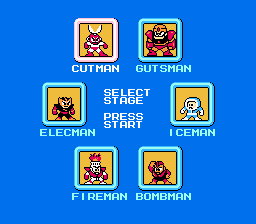
Mega Man was the most prolific series on the NES, beginning with the first game in 1987, and ending with Mega Man 6 in 1993.  While some games are considered superior to others, Capcom did an impressive job of keeping the quality high throughout the entire series.  There's certain aspects you know you can expect when you play a Mega Man game: being able to play the first eight (or in the first game, six) levels in any order, obtaining a boss' weapon after you beat them, phenomenal music that's different on every level, and a high degree of difficulty, strategy, and control.

The official story behind Mega Man 1 is that evil Dr. Wily has reprogrammed robots originally designed for menial labor.  While there's no opening cutscene to explain this in-game, the art and design elements do a good job of conveying it.  The majority of robots have a clear non-combat purpose (pick ax robots, demolition robots, car crusher robots, etc), and most levels appear to take place in a realistic location (construction site, polar research area, etc).  I especially love the final level, which appropriately takes place inside a robot factory - what more logical location could there be for Wily's lair?

Mega Man 1 is one of the least popular entries in the series (probably second only to Mega Man 6), and this is because it's also the most difficult game in the series.  A big reason why Mega Man games are still popular to this day is because every obstacle and enemy in the game is completely avoidable, with enough skill and strategy, but you also have a health meter that lets you decide when it's worth it to take a hit or two.  While that holds true in this game in well, there's still quite a few quirks: falling off ladders when you unpause, dying instantly on spikes even when you're flashing invulnerable, falling instantly at super-speed when you miss a jump from a moving platform, etc.  That, combined with a few seemingly "unfair" elements - "normal" enemies that take a third of your health with one hit, for instance - held this entry back from feeling like a true masterpiece.

Graphics & Animation: 3 (Good)
The graphics here are great.  There's six Mega Man games produced for the NES over a span of seven years, and the main character's designs stayed almost exactly the same throughout all six games.  That's an impressive testament to how well Mega Man and his cohorts were designed. The sequels would improve upon the formula with moving backgrounds, oversized enemies, and colorful cutscenes; but still, there's a cutscene as you prepare to enter each level, and Dr. Wily flies away in his spaceship once you've beaten the first six stages.  This was better then anything else on the NES in 1987, and it would only get better as the series progressed...

Music & Sounds: 4 (Excellent)
One of the hallmarks of the Mega Man series is the incredible music.  Every level in the game has a different, full-length theme song!  This was unheard of in 1987, and still impresses even today.

Controls & Level Design: 3 (Good)
Mega Man 1 has the worst controls of any Mega Man game for NES, but that means it still has tighter controls then 90% of the NES games out there.  While the strategy and skill are definitely present (trying to rush through any given level will always get you killed faster then taking your time and being strategic), it lacks the refinement of later games in the series.  The level design is also a little uneven; while some areas seem very unforgiving (like the moving platforms in Gut Man's stage), other aspects seem too easy (such as bosses that die in three hits using the right weapon).

Story & Presentation: 4 (Excellent)
Mega Man 1 has some of the best theming out of all the Mega Man games.  I couldn't even begin to tell you what function Snake Man from Mega Man 3 would serve, be it combat or civilian, and I have no idea where or how his snake-themed level is suppose to be taking place.  In this game, the locations and functions of the robots seem a lot more defined, giving you a sense of the story without you having to read the manual or a text intro.

Length & Replayabilitiy: 3 (Good)
The Mega Man games were designed to be challenging, so that you'd keep replaying the game and learning all the possible patterns and strategies. The fact that you can do the first eight (or in this game, six) levels in any order add to the replayability, because any time you're stuck you can just stitch to a different level.  That being said, length is definitely the Archie's heel of this game - it has only ten stages in all, making it by far the shortest Mega Man game for the NES.

Total: 17 (Good)