Showing posts with label 1990. Show all posts

Wednesday, February 3, 2016

Battle Chess

Name: Battle Chess
Year: 1990
Publisher: Data East
Developer: Beam Software
Genre: Board Game
Hours Played:
Beaten: No, I suck at chess
Battle Chess was a novelty game for computers and consoles in the late eighties/early nineties.  The concept is simple: it's just standard chess, but when you move, the pieces get up and walk around, and when you capture another piece, you get to watch the two characters fight each other.  The game is loaded with over 100 animations, as every possible paring of pieces has it's own unique battle animations, and the charm of the game comes from the different character's personalities: knights creak and lumber around the board, rooks transform into rock monsters, etc.

Although it's not widley remembered now, Battle Chess was very popular (espicially for PC) and spawned a number of sequels and spinoffs; however, unlike contemperary cult classics like Archon, there doesn't seem to be any indication of a Battle Chess remake or revival or Kickstarter (EDIT: turns out I was wrong).  That's because unfortunately, like all novelties, the novelty of Battle Chess eventually wears off.  The appeal of the game is to show off your hardware to your friends, and see how many different kill animations you can discover; once you've done that, you're left with a pretty standard chess simulation.  If you just want to play chess on your NES, you're better off sticking with Chess Master: it has a teaching mode for beginners and better AI for experts.  But if you want your friends to think you're smart while watching medieval characters kill each other, there's always Battle Chess.

Graphics & Animation: 4 (Excellent)
The animation is the showcase here, and the NES does a pretty good job of mimicking it's PC brethren.  There's over a hundred different battle animations (one for every possible combination of attacker/defender), and each piece has it's own distinct personality.

Music & Sounds: 2 (Average)
This is one case where I don't mind the lack of music during the main game, as true chess players would probably find it a little distracting.  The grunts and groans of the combatants are a nice touch, though.

Controls & Level Design: 1 (Bad)
The game controls just fine (although I wish it had a cancel button), and I can't really fault chess for a lack of level design.  My main complain here is the lack of options; compared to Chess Master, this is a pretty bare-bones representation.

Story & Presentation: 4 (Excellent)
This cartridge may have more cutscenes then any other single NES game, thanks to all the unique battles between the pieces.  The game has a style all of it's own - it's actually pretty violent for an NES game.

Length & Replayabilitiy: 1 (Bad)
Trying to find every combination of pieces will keep you entertained for a little while... but after that, you'd better really like chess.

Total: 12 (Average)

Wednesday, January 20, 2016

Sesame Street: Big Bird's Hide & Speak

Name: Sesame Street: Big Bird's Hide & Speak
Year: 1990
Publisher: Hi-Tech Expressions
Developer: Riedel Software Productions
Genre: Educational
Hours Played: One
Beaten: Yes
Sesame Street: Big Bird's Hide & Speak is the third Sesame Street game released for the Nintendo Entertainment System; it's also the first one to be created specifically for the console, and the first NES game of any kind to feature digitized speech (i.e. the game talks).

When you start up the game, you're greeted by several walls of text (with copyright statements, credits, etc), and then an impressively large graphic of Big Bird skates onto the screen and gives you a choice of six different mini-games.  Oddly, there's no title screen with the game's name (unless you count it being crammed in among the walls of text), and no name or description for any of the games.  I guess they figured their target audience couldn't read anyways?

The format of each game is simple.  Four random Sesame Street characters (the only ones I've seen so far are Ernie, Bert, The Count, Grover, and Elmo) go inside the famous Sesame Street apartment building, and take their places at four different windows.  Big Bird comes out from hiding and issues you a question, and Little Bird is used as a cursor.  You select the appropriate window, and once you've answered four questions correctly, one of the characters comes out of the building and does a little animation to celebrate (Elmo blows a bubble, The Count juggles numbered balls, etc).

The six games comes in three different flavors: two of them are about identifying the correct Sesame Street character, two are about finding the correct letter, and two are about spelling three-letter words. In the first game, the four characters are clearly visible, and you just pick the one Big Bird asks for.  In the second, you see the characters for several seconds, and then the windows close and you have to remember where each one was.  The third and fourth are repeats of the first two except each character has a letter, and Big Bird asks for letters instead of names.  On the fifth game, you have to spell a word using three of the four letters available, and in the sixth you have to spell as many words as you can before a cartoon sun reaches the bottom of the screen.

On the whole, as an educational game, this one works all right.  The overly simple controls and Big Bird verbally speaking instructions makes this game playable even for very small children.  There's not much to be learned from the "find the characters" modes, since you don't even have to guess at their location (as you would in a game like Memory); the real meat of the game seems to be learning your letters and spelling.  It's not the best letter and spelling game I've ever played, but it is the best one I've found so far on the NES.

Graphics & Animation: 3 (Good)
Bird Bird and his friends are all nicely rendered here.  The game doesn't have too many sprites, so the developers wisely put that extra space to use with oversized sprites for all the characters.  The Big Bird that skates onto the title screen is particularly impressive for the NES.

Music & Sounds: 3 (Good)
Big Bird talks!  The digitized speech isn't perfect; I had trouble telling if he was asking me for a "b" r a "v".  Still, for the first talking NES game, it's hard to be too critical; even by 1994 (the end of the NES's life cycle), this was still impressive.

Controls & Level Design: 2 (Average)
If you read my review for Sesame Street: A-B-C, you know how frustrated I was that the game won't accept valid words if it's not the word the game is looking for.  I've played several rounds of Big Bird's Hide & Speak and haven't come across this problem.  The controls here are almost frustratingly simplistic, but that's appropriate for the target audience, and you can quickly jump back to the main menu at any time.

Story & Presentation: 2 (Average)
It's odd how text-free the menu screens are.  Don't be fooled by the screen shots; when you play the game, it's really easy to miss the "title screen" among the other screens of text that flash by.  I am however impressed by their dedication to recreating not only the characters but the sets from Sesame Street; the famous brownstone apartment building is instantly recognizable, as is the made-from-doors fence that surrounds Big Bird's nest.

Length & Replayabilitiy: 1 (Bad)
My only real complain about this game is I would have liked a couple more modes; maybe numbers in addition to letters, or at least a harder version of the find-the-characters game.  The game as it stands is a little on the simplistic side, but it's still heads and shoulders over games like Fisher Price: I Can Remember.

Total: 11 (Average)

Monday, January 18, 2016

Super Mario Bros. 3

Name: Super Mario Bros. 3
Year: 1990
Publisher: Nintendo
Developer: Nintendo
Genre: Platformer
Hours Played: Countless
Beaten: Yes, countless times
In a lot of ways, Super Mario Bros. 3 was Nintendo's swan song for the Nintendo Entertainment System.  It wasn't the last game they produced for the NES, not by a long shot, but after five years (longer in Japan) of producing games for the eight-bit system, this would be their last concentrated effort before focusing their best and brightest on the NES's successor (the Super Nintendo, released one year later).

Looking back now, it's hard to imagine the hype for this game (everything from commercials to feature-length films), but people were excited, and the game did not disappoint.  Even today, it's generally considered to be the all-time best Mario game, and sometimes even the best game ever made.  Although that last one may be going a little far, there's no doubt that it's an enduring classic that's aged well even today.  But sinse we here at All Game Revue frown at taking a game's legacy in account, let's take a look at the game itself and see if it holds up well against it's NES brethren.

The original Super Mario Bros. was an exceptional platformer that set the standard for what people expected on the NES.  The second game took the series in a different directions and left a lot of fans scratching their heads.  Super Mario Bros. 3 returned to the formula of the original game and expanded upon it in every way possible.  There were more power-ups.  You could now play levels in different orders.  You could even collect power-ups and save them for later use.  Every single enemy from the original game not only returned, but received either upgrades or new variants, and their were a host of new and memorable enemies as well.

The only downside?  I wouldn't call the game "rushed", considering how many levels it has (around ninety!), but there's definetly concepts that don't feel fully utilized.  Fan-favorite items like the Tanooki Suit, Hammer Bros. Suit, and Goomba's Shoe appear in only one or two places in the game; I've often wished they'd placed the suit-wearing gimmick at the forefront of the game (like Capcom's Little Nemo: Dream Master), as it's such an interesting and fun idea.  Still, even this has become one of the game's charms; while most NES games were conservative with their limited resources and wouldn't introduce a power or enemy unless they could use (and reuse) it to it's fullest, Mario 3 wasn't afraid to throw tons of things against the wall to see what sticks.  That's what made it an enduring classic, then and now: you never know what to expect next.  I've been playing this game for over 25 years, and it can still surprise me; that's pretty darn cool.

Graphics & Animation: 4 (Excellent)
The graphics here are terrific!  Nintendo took the already-iconic character designs of the first game and gave them bold black outlines to really make them pop from their surroundings.  The enemies have tons of personality, and the transformations of the kings still makes me smile today.  Nintendo re-released this game with a graphical update (both in Super Mario All-Stars and Super Mario Advanced 4), and a lot of people (including myself) still prefer the original.

Music & Sounds: 4 (Excellent)
Nintendo actually included a special sound chip in the cartridge to create all the drum effects in the game.  The result is music that doesn't sound like anything else on the NES, and really showcases what the machine is capable of.

Controls & Level Design: 4 (Excellent)
The controls here are spot-on.  The level design is excellent, knowing when to show off new features (like flying with the raccoon power-up) and when to give you a straight-forward challenge.  The game is constantly throwing something new at you, meaning you never get bored, and you're always waiting to see what's coming next...

Story & Presentation: 3 (Good)
The presentation here is very creative, with the game being presented as a stage show (complete with curtains and props you can walk behind).  The story is a little lackluster; although it progresses through static cutscenes (letters from the Princess between worlds), it doesn't really go anywhere until (SPOILERS! I guess?) she's kidnapped at the begging of World 8, begging the question of what exactly your quest was before.  Also, the bosses are pretty underwhelming; compared to the giant enemies of the Mega Man series, the bosses here aren't even as intimidating at the normal enemies in World 4.  Still, the gimmick of the kings being turned into animals is pretty entertaining, and it keeps you playing the game to see what animal will be sitting on the throne next.

Length & Replayabilitiy: 4 (Excellent)
This is (in my opinion) the game's greatest strength; Super Mario Bros. 3 is easily one of the most replayable games on the NES.  The full game is massive, but the warp flutes allow you to explore at your leisure; you can skip straight to the end, jump around to your favorite worlds, or try to beat the whole game front to back.  To this day, I still haven't beaten level in the game; World 7 in particular continues to frustrate me, and yet that's never deterred me from loving the game or coming back for more!

Total: 19 (Excellent)

Wednesday, January 6, 2016

Mega Man 3

Name: Mega Man 3
Year: 1990
Publisher: Capcom
Developer: Capcom
Genre: Platformer
Hours Played: Countless
Beaten: Yes, without cheats
Mega Man 3 is easily the second most popular game in the series; discuss how great Mega Man 2 is anywhere on the internet, and fans will always come out of the woodwork to tell you they prefer the third game.  This devotion comes not because Mega Man 3 is the most polished of the series, but because of it's atmosphere and storytelling techniques.

The overall theme of Mega Man 3 seems to be "mystery".  There's question mark containers sprinkled throughout levels with random contents.  After beating the eight levels, four of the areas are seized by mysterious robots, and selecting one causes a question mark to appear where a robot master would normally introduce themselves.  Most mysterious of all is a new character, similar to Mega Man but red, who appears in various levels, sometimes as a miniboss and sometimes to help you out.  The most innovative and memorable thing about Mega Man 3 is the way the game reveals who this character is and why he's important without using a lot of dialog or backstory; it pushes you to keep playing the game to find out more about him.

While the sub-plot about the mysterious robot is beautifully told, the game's main plot is a confusing mess.  The game starts out with a melodic song where their clearly should have been an opening cinematic scene explaining the story thus far, but there isn't one.  Dr. Light shows up halfway to deliver the shocking twist that Dr. Wily (series antagonist) has turned evil - was that suppose to be a surprise?  Apparently according to the manual, the plot is that Dr. Wily has renounced his evil ways and was working on a peace-keeping robot (called Gama) with Dr. Light.  So the idea is that the eight different levels take place on different mining planets (I guess), each headed up by a robot master who's went berserk, and you have to defeat the robots to get the elements that Wily and Light need for Gama?  I think?  Except the robots are berserk because Dr. Wily has taken control of them, except he still can't use them to get the elements himself?  For some reason?

The levels in this game are a hodgepodge.  Staring with Mega Man 2, Capcom would hold contests in Japan to allow people to design robot masters, and then they'd use those designs in the games.  The result of this is sometimes having a robot master who is seemingly unrelated to the level they rule over, such as Flash Man's ice level in Mega Man 2.  In most Mega Man games, this really only happens for one or two stages, but here it feels like most of the levels and their bosses were paired up randomly.  Shadow Man has a fire level, Top Man rules over a greenhouse, Gemini Man rules an ice and water level... but then on the other hand you have Snake Man, who's level is so on the nose (the level is literally made out of robot snakes) that it's probably the most over-the-top level in the whole series.

Series creator Keiji Inafune has stated that after the runaway success of Mega Man 2, Mega Man 3 was rushed to production; unfortunately, the final product shows.  The fine-tuning and polish from the last game are missing here.  New items (the Rush Jet and Rush Marine) are poorly implemented, and the controls are sloppy (for a Mega Man game).   The game will always hold a special place in many gamer's hearts (including myself) for teaching us that a game could convey a story through gameplay rather then exposition, but after the perfection of Mega Man 2, it comes off as just a little bit of a disappointment.

Graphics & Animation: 4 (Excellent)
This was the game in the series that really cemented the oversized enemy sprites.  In Mega Man 2, you saw them with minibosses, but here, just regular enemies that used to be 16x16 sprites have been redrawn to be 32x32.  It gives the whole game a super colorful, super cartoony look.  You can argue that it also makes the enemies a little less menacing then they were in Mega Man 2, but they have so much personality that it's hard to complain.

Music & Sounds: 4 (Excellent)
The music here is once again incredible; the opening theme in particular, both moody and melodic, is some of the best in the entire series.

Controls & Level Design: 3 (Good)
The controls here are still good, but just not quite up to the par set by the other games in the series.  Until Mega Man 4, Capcom built a new game engine from scratch for each new Mega Man game, and Mega Man 3's has some funny quirks.  You're unable to pause the game and access the menu if any of your bullets are still on-screen, and this can cause some serious problems, especially if you've fired the Gemini lazer (which can bounce around the boss room quite a bit before disappearing) and you need to access an energy tank.  Likewise, the level design is also good, but feels just a little rushed.  There's never any areas where the Rush Marine can be used to it's full potential, and there's a Rush Jet-heavy level where dying in the middle basically means you're screwed; having the weapon refills reappear would have really made things simpler here.

Story & Presentation: 3 (Good)
The presentation here is good, don't get me wrong, but I really miss the opening cut scenes that all the other Mega Man games (except the first one) have.  The sub plot about the mysterious Proto Man is very cleverly told through game play, but the game's main plot baffles me.

Length & Replayabilitiy: 3 (Good)
Mega Man 3 has four more levels then it's predecessor, giving the game an impressive length for an NES platformer.  Still, the lack of polish (Mega Man 3 is infamous among perfectionists as the only game in the series where it's impossible to beat the game without taking a hit, due to a couple of undodgeable boss attacks) and no difficulty setting make it a little less enduring then it's predecessor.  Mega Man 2 was a game you couldn't wait to beat again and see if you could do better; Mega Man 3 was a game you couldn't wait to finish, see how the story came out, and then be done.

Total: 17 (Good)

Monday, December 21, 2015

Fisher-Price: Perfect Fit

Name: Fisher Price: Perfect Fit
Year: 1990
Publisher: GameTek
Developer: Beam Software
Genre: Educational
Hours Played: Half an Hour
Beaten: Yes
Like all three NES Fisher-Price games, Perfect Fit began life as a DOS game.  The computer operating system that preceded Windows, DOS was primarily text-based, and while some (but not all) DOS games did have graphics, they tended to be crudely drawn, have a limited color palette, and more often then not they featured either no music, or a public domain soundtrack (i.e. classical music, children's songs, etc).  As was only natural, when the Nintendo Entertainment System gained popularity in the US, a lot of computer companies ported their previously DOS-only games to the NES.  Since the NES was technically superior, these conversions tended to be upgrades: better graphics, real music, etc.  Not so with Fisher Price: Perfect Fit.

The idea here is that the game gives you one picture at a time, and you have to match that picture to it's outline on a grid.  On easy, you literally just move the picture over it's outline and hit the button.  On the hardest setting, the picture might be backwards or upside down, and there's buttons that let you flip the picture to straighten it out.  That last bit would actually be pretty clever, except with some of the pictures it's a little too subtle; for instance, the only way to tell the Fisher-Price cassette tape is backwards is to look for the FP on the label.  Speaking of which, the Fisher-Price product placement makes a return here, but there's also letters and numbers to place, giving the game a modicum of educational value.

All in all, Perfect Fit is a pretty poor excuse for a game.  Some may question whether it's even worse then Fisher Price: I Can Remember; after all, Memory is a real game that people pay money for, and at least it has some arguable educational value.  To those remarks, I say this: number one, Perfect Fit isn't included as a free mini-game on hundreds of other video games, and number two: while I didn't enjoy playing Perfect Fit, I also didn't fall asleep.  That's faint praise, though; this is still easily one of the worst games on the NES.

Graphics & Animation: 0 (Awful)
Although several of my sources tell me this was originally a DOS game, MobyGames has it listed as NES only.  If that's true, they sure went through a lot of trouble to make this look like shoddy 80's PC shareware.

Music & Sounds: 0 (Awful)
PCs in the eighties only had one sound channel.  The NES had five.  Guess how many this game uses?  Feel like hearing public domain children's song blared at top speed one note at a time?  Then you're in luck!

Controls & Level Design: 1 (Bad)
The whole game is about lining up pictures over their shadows.  Well, you'd better make sure you've lined it up exactly, because if you're off by even a little bit, the game tells you you're wrong.  When you're aiming your game at very small children, this is inexcusable.

Story & Presentation: 0 (Awful)
The best thing I can say about this game is that they got rid of the annoying angry buzzer from I Can Remember.  Sure, navigating the menus is still unintuitive, but at least the game no longer punishes you for not being able to figure it out.

Length & Replayabilitiy: 1 (Bad)
Perfect Fit has a two player mode, a versus the computer mode, a solo mode, and three levels of difficulty.  If this was a five dollar shareware game for PC on the eighties (which I suspect it was), I'd actually be pretty impressed by it.  But as a fifty dollar game for the NES, this is just a mess.

Total: 2 (Awful)

Fisher-Price: I Can Remember

Name: Fisher-Price: I Can Remember
Year: 1990
Publisher: GameTek
Developer: Beam Software
Genre: Educational
Hours Played: Don't know, fell asleep
Beaten: Yes, at least once
When I started this blog, I picked for my first post Color a Dinosaur, because I was confident it would be the worst game I ever reviewed for the NES.  Well folks, I'm only about thirty games in, and I may have found one that's worse.  I've played a lot of bad video games, but I've never in my life found myself nodding off during a game before.

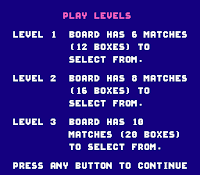
At it's core, I Can Remember is just a game of Memory.  There's a set number of cards on the table, and you take turns flipping over cards two at a time; if the two cards you pick match, they disappear and part of a picture appears below.  Match all the cards, and the entire hidden picture is revealed. Not particularly inspired, but unlike, say, dinosaur coloring, it's at least an actual game you can actually play.  So what exactly is the problem here?

Well first of all,  everything in this game takes forever.  You pick a card, it slowly flips over.  You pick a second card, it slowly flips over.  They don't match?  They slowly flip back.  They do match?  They slowly disappear, and the hidden picture slowly reveals itself.  I literally found myself fighting to stay awake at one point.  Secondly is the pictures themselves: they're all Fisher-Price toys!  You can flip over cards with toy telephones, or ring stacks, and when you reveal the hidden picture, it might be a rocking horse!  All available at your local toy store!  I see people mock games like M.C. Kids for their in-game product placement, but this is about the worst I've seen that wasn't a free game included in a box of cereal; even the Burger King would be embarrassed by this.

But the biggest problem here is just how little effort seems to have went into this.  Seriously, this is the first NES game I've ever played where I've seriously wondered if it was made by one guy.  For instance, if you play on the highest difficulty level, the game deals out twenty cards, and they fill the screen.  So when you pick the easiest setting and it deals only 12 cards, how do you think the developers handle it?  Scale the cards up to fill the screen?  Have blank spaces at the top and bottom?  Nope!  The game still shows twenty cards, but if you try to pick from the top four or bottom four, the game buzzes angrily at you to let you know that you're in the wrong.  Yeah, that's definitely pretty educational!

On a personal note, I dabbled in amateur game design myself for a little while.  I was honestly pretty terrible at it, but even I managed to make a playable Memory game.  Do you know why?  Because Memory is one of the easiest games to program.  Seriously, when you're teaching people how to program games, it's usually the second game you teach, right after "guess a number".  There's a reason why it's such a common mini-game in other games you buy.  For fifty bucks in the nineties, you could buy Super Mario Bros. 3, with a card matching mini-game that's infinity better then this one, AND the entire game of Super Mario Bros. 3 to go with it!  Or, you could pay fifty bucks for an advertisement from Fisher Price.

Graphics & Animation: 0 (Awful)
This game looks terrible.  I had no idea it was possible to replicate CGA graphics on the NES, and I still have no idea why you would want to, but they sure pulled it off!

Music & Sounds: 0 (Awful)
All the music here public domain.  Yeah, unlike Color a Dinosaur, which had you coloring your dinosaurs mostly in silence, there's plenty of music here; you're constantly assaulted with super-loud renditions of Old MacDonald and Twinkle Twinkle Little Star.  And don't even get me started on the awful buzzing sound when you're wrong, or if you just do something the game doesn't like.

Controls & Level Design: 0 (Awful)
Before you're allowed to play, the game forces you to pick a name, even if you're playing by yourself.  You're given a grid of letters, and you pick letters to spell your name.  Now, in most games, hitting left when your cursor is on the left-most side would cause it to jump over to the right-hand side, and making a name of the maximum length would cause the cursor to jump automatically to "done".  Not only does this game not include these small but handy features, but it actually buzzes angrily at you when you try to do them!  There's even a couple of blank spaces the developers left there out of sloppiness, and you get buzzed for trying to pick them, too.  This is the kind of design and controls we're talking about; the game hasn't even started yet, and I'm ready to hurt somebody.

Story & Presentation: 0 (Awful)
This was originally a DOS game, and it's almost impressive how little work they clearly did to move it over to the NES.  It's not that DOS games are terrible by nature, it's just that they're technically inferior to what the NES can offer.  This should have been an upgrade, not a lateral move.

Length & Replayabilitiy: 0 (Awful)
This is the only category I considered giving the same a (single) point in.  Yes, it does have one and two players, play against the computer, and play against yourself, and there are three levels of difficulty, so clearly they put a little effort in, right?  That's until you actually try the different modes and see how little effort was put into each one of them.

Total: 0 (Lowest Possible Score)
Sunday, November 8, 2015

Solstice

Name: Solstice
Year: 1990
Publisher: CGS Imagesoft Inc.
Developer: Software Creations Ltd.
Genre: Isometric Platformer
Hours Played: Countless
Beaten: Countless times
To say that isometric puzzle platformers are a niche genre is something of an understatement.  They were fairly popular on computers in the early eighties, with popular titles including Knight Lore, Spindizzy, AirBall, and Mystic Towers, and there was a handful released for the GameBoy, including Altered Space and Monster Max, but only one was ever released for the Nintendo Entertainment System: Solstice.

So what is an isometric puzzle platformer?  Well, first of all, the games have an isometric point of view - a faux-3d perspective viewed at an angle, as seen in Sonic 3D Blast, Super Mario RPG, or StarCraft II.  The games takes place inside a single castle or dungeon (in this case a castle with multiple towers, gardens, and catacombs) and have a sprawling metroidvania feel where you collect items, backtrack, and open up new areas.  Puzzles involve dropping blocks over spikes or on top of enemies to ride them over obsticles, and the item collecting tends to focus on fetch quests rather then powering up your character.

Solstice is unlike any other game on the NES - so much so that most gamers didn't know what to make of it.  Most online reviews seem to focus on how the reviewer was disappointed the game wasn't more like Legend of Zelda.  The truth is, Solstice is a high quality game, and clearly a labor of love, but it was clearly intended for people familiar with the genre.  For instance, block jumping - an advanced technique from Knight Lore where you drop a block in midair while hitting the jump button to double jump - is required in quite a few instances in the game, but isn't explained in the manual or shown in the demo.

All in all, Solstice is a well-crafted game, but it has a high difficulty curve, and it doesn't hold your hand.  There's colored coded potions that provide different effects necessary to beat the game, but nothing in the game provides any explanation on what they do. If your familiar with the controls and the playstyles, Solstice can be beaten in about twenty minutes,  but games unfamiliar with the genre will long for a save file or unlimited continues.  In short, it's not a game for everyone, but it's worth playing at least once, if only for the graphics and music.

Graphics & Animation: 4 (Excellent)
The graphics in Solstice are very striking.  The predominate color on the screen at all times is black, which adds to the atmosphere of the game.  All the outdoor segments appear to be taking place at night, a stark contrast to the overly colorful platformers that flood the NES - and yet the color pallet of Solstice never feels muted or murky (as in games like Faxanadu).

Music & Sound: 3 (Good)
The good news: Solstice has two of the best songs to ever grace the NES.  I kid you not - the game is very well known for it's music, and a favorite of NES cover artists.  The bad news - they're the only two songs in the whole game.  Granted, their both over three minutes long - extremely impressive for the time - with a lot of progression and different instruments, but it's still only two songs.  Well, okay, to be fair, there's a handful of other tunes - the opening cutscene music, the ending cutscene music, the game over music - but each of those are only a few seconds long.  In short, the music's fantastic, but hearing only one song the entirety of the game can get a little old.

Controls & Level Design: 2 (Average)
The main thing that turns people off about isometric games is the controls.  Up is northeast not north, down is southwest not south, etc.  It helps if you hold your control at an angle, but once you get used to it you won't even notice.

Story & Presentation: 3 (Good)
This game has a ton of cutscenes - one at the beginning of the game, one at the end, and everytime you pick up an item there's a full screen picture along with it's name (similar to Wizards and Warriors).  But like Metroid, what really sells the story of this game isn't in text or in cutscenes, but the mood of the game.  There's no townspeople or friendly characters to talk to, no scrolls with hints or clues to pick up - in fact, except for when you pick up an item, there's no in-game text at all.  It helps give the game a stark atmosphere.

Length & Replayability: 3 (Good)
The 255-room Kastlerock is impressively sprawling.  There's four towers, three "gardens" (outside areas), and two underground sections, one of them a huge labyrinth.  Although visiting every room and collecting every item isn't necessary to completing the game, you've given a percentage score during the credits, encouraging you to find everything, which adds to the replay value.

Total: 14 (Good)

Tuesday, November 3, 2015

Spot

Name: Spot
Year: 1990
Publisher: Virgin Mastertronic International, Inc.
Devloper: Vargin Mastertronic Ltd.
Genre: Board Game
Hours Played: 3
Beaten: Yes, without cheats
People who grew up in the late eighties/early nineties will probably remember Cool Spot, the anthropomorphic sunglasses-wearing 7up logo. He had a couple of platformer games for the Super Nintendo and Sega Genesis, but less remembered is his board game-style NES outing.

Okay, so this one surprised me.  I was always under the impression that Spot was a quickly thrown together 7up-themed Othello/Reversi game.  What I found instead was an original four-player board game with it's own unique personality.

Each turn, you can either add a piece to the board, or move a piece.  An added piece must be adjacent to an existing one, but a moved piece can hop across the board.  Enemy pieces are captured, not by cornering like in most games of this type, but simply by putting a piece adjacent to them.  That probably doesn't sound like anything special, but the resulting game is surprisingly brutal.  Being able to move a piece prevents you from getting trapped in a corner, but it also frees up that space for your opponent to move in, leaving a lot of strategy for when you should move and when you should add.

Graphics & Animation: 3 (Good)
The graphics in this game have a lot of personality.  All you're really doing is moving checker pieces around, but they get up and walk, dive towards their destination, moonwalk, and stop their feet when you're capturing pieces.  It's an impressive amount of attention to detail.

Music & Sounds: 1 (Bad)
There's only a couple of (forgettable) songs in the game, and they repeat over and over. And over.

Controls & Level Design: 2 (Average)
The good news is, the cursor glides nicely from grid space to grid space with the D-pad.  The bad news is, to play you have to click the piece you want to move, then click the space you're moving it to.  It's intuitive if you're expecting checkers, but since it looks like an Othello or Go style game, I actually thought the game wasn't working and had to look up instructions.  Fortunately, there's a demo that plays after the opening game that teaches you how to play; unfortunately, it doesn't explain the controls.

Story & Presentation: 2 (Average)
There's no story per say (it's a board game after all), but there are a couple of brief cutscenes for when you win or lose, showing a cheering or booing football stadium.

Length & Replayability: 3 (Good)
The average time of one round is pretty short, and there's no tournaments or modes to pick from.  What make the game impressive, though, is the large amount of boards you can play on.  Each board makes for a very different game, and you can easily modify them and create your own boards, adding to the replay value.  Between the multiplayer (up to four people!), the numerous board options, and ability to make your own board, there's a lot to do here before it gets old... but at the end of the day, there's only one difficulty level and only one game mode.

Total: 11 (Average)